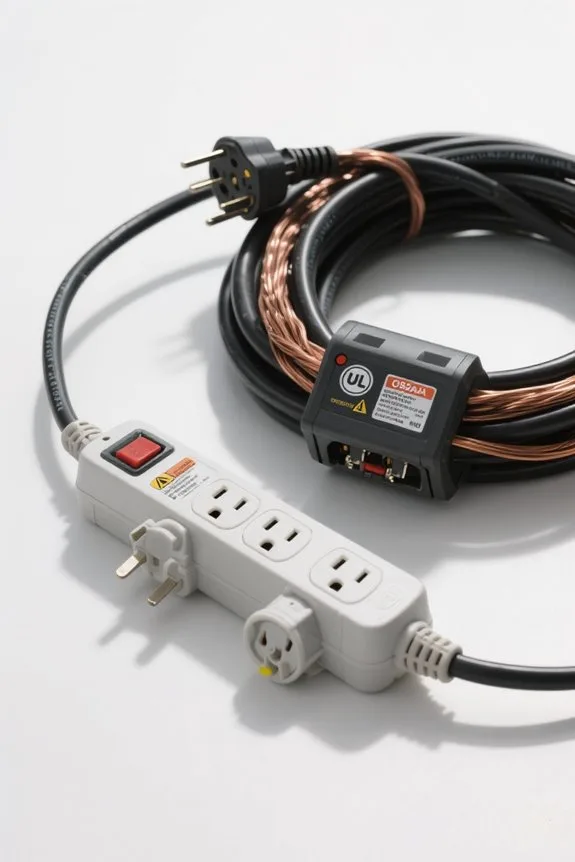
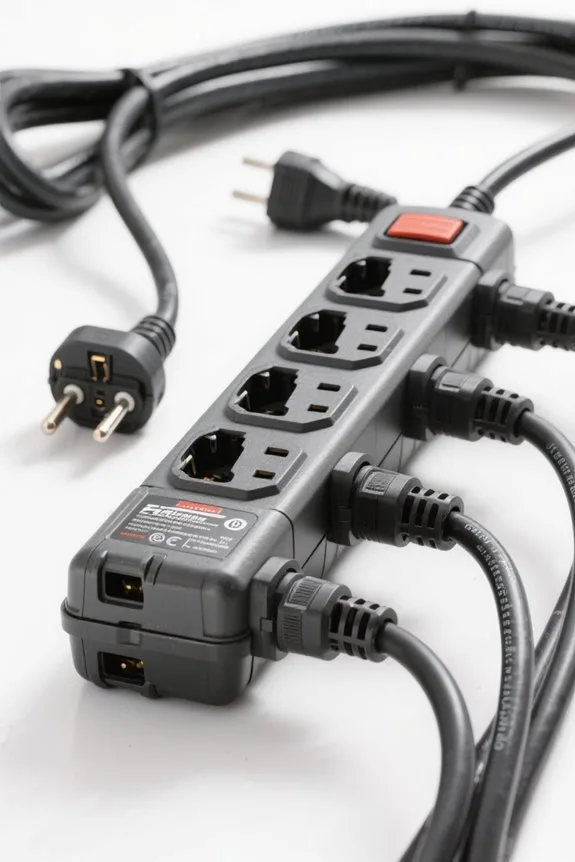
As an Amazon Associate, we earn from qualifying purchases. Some links on this site are affiliate links at no extra cost to you. Our recommendations are based on thorough research and editorial judgment.

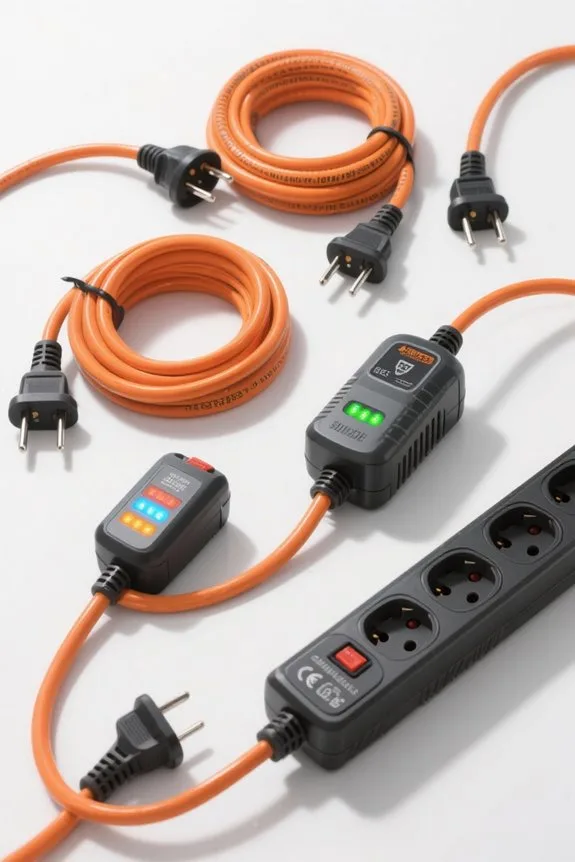
Fire Hazards: Extension Cords and Surge Protectors

It advises that extension cords labeled UL 14 AWG, 15A, are for temporary use and not permanent wiring. Inspect cords for frayed insulation over 1/4 inch, exposed conductors, loose plugs, cracks, discoloration, or burning odor. Do not daisy chain power strips, plug high-wattage appliances like space heaters into light-duty strips, or exceed 15A per circuit. You can use UL-listed surge protectors with resettable breakers, GFCI as needed, and follow OSHA/NEC routing and documentation for details.
Key Takeaways
- Extension cords are for temporary use only; prolonged use increases fire risk and cannot replace permanent wiring.
- Use UL-listed cords 14 AWG or heavier, rated for device amperage; undersized cords can overheat and ignite.
- Never daisy-chain power strips or extension cords; plug strips directly into wall outlets to avoid overloads.
- Inspect cords and strips regularly for frayed insulation, exposed conductors, melted plastic, or burning odors; discard damaged units immediately.
- Do not power high-wattage appliances (space heaters, refrigerators) from light-duty cords or strips; use permanent circuits or GFCI-protected outlets.
Why Extension Cords Are for Temporary Use
You may be interested
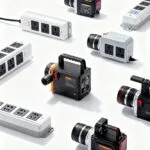
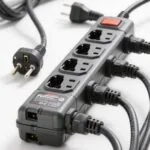
Prudence dictates that extension cords be used only temporarily to avoid predictable electrical hazards. Regulations state extension cords are temporary wiring and must not replace permanent circuits, per OSHA guidance. Using cords beyond 90 days converts them to permanent wiring, raising documented fire hazards and inspection violations. Select UL-listed 14 AWG or heavier cords, 15A rated, 120V compatible, NEMA 5-15 plugs for light-duty devices only. Step 1: unplug the cord, Step 2: inspect connections, Step 3: remove immediately when task completes to prevent overheating. Avoid powering high-energy appliances such as space heaters or refrigerators with light-duty cords, which can overheat and ignite. Employ temporary wiring only for short-term tasks, document use duration, and replace with permanent wiring installed by certified electricians, preserving basic electrical safety compliance today. For workshop protection, select surge protectors rated at 2,700 joules or higher to protect heavy-duty tools.
Recognizing Damaged Cords and Power Strips
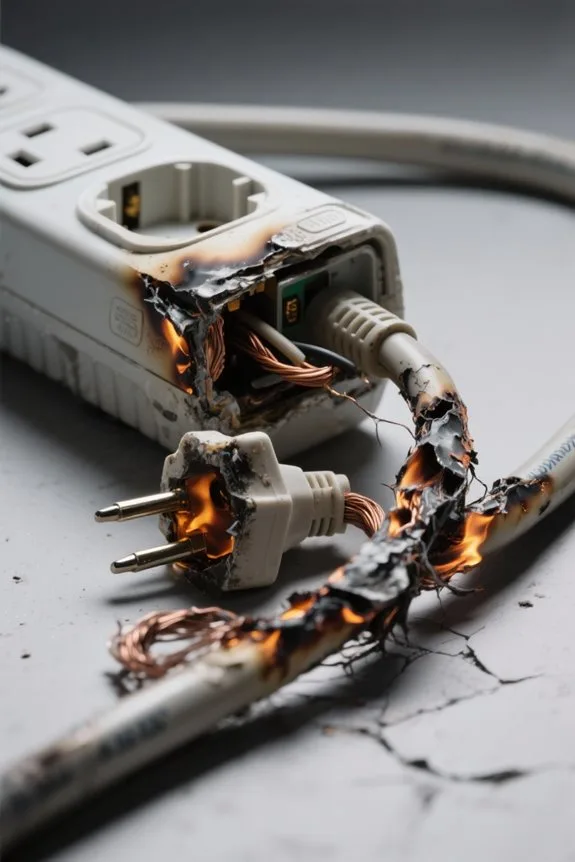
After using temporary wiring, inspection for damage should follow immediately to prevent hazards. Routine checks target frayed insulation, exposed conductors, loose plugs, and cracks in jackets on any Extension cords in use. Inspect power strips for discoloration, melted plastic, burning odor; immediately disconnect units that feel hot, preventing serious electrical hazards. Measure cord length and gauge, for example 6-foot, 14-gauge, and verify UL marking, equivalent listing on the product label. Confirm power strips have a resettable breaker; press the reset button and confirm it resets within 2 seconds. Damaged cords or power strips with exposed wires or cracked housing should be disposed of, and never repaired. Record inspections on a log with date, model number, action taken, retain records for at least 12 months. Ensure extension cords and power strips meet a 13A/125V rating for safe household use.
Recommended Products

Sleek Cubic 3-way Design: Unlike traditional extension cord, the smart-looking white extension cord 6 feet features 3 grounded outlets on different sides, allowing you to plug in multiple appliances without blocking neighboring outlets. Max 1625W (125V/13A).NOTE: Not for recessed floor outlet

3-OUTLET EXTENSION CORD — Convert one grounded outlet into three grounded three-prong outlets to power multiple electronics at one convenient location, perfect for home offices, media centers and workspaces

3-OUTLET EXTENSION CORD — Convert one grounded outlet into three grounded three-prong outlets to power multiple electronics at one convenient location, perfect for home offices, media centers and workspaces
Proper Use of Power Strips and Surge Protectors
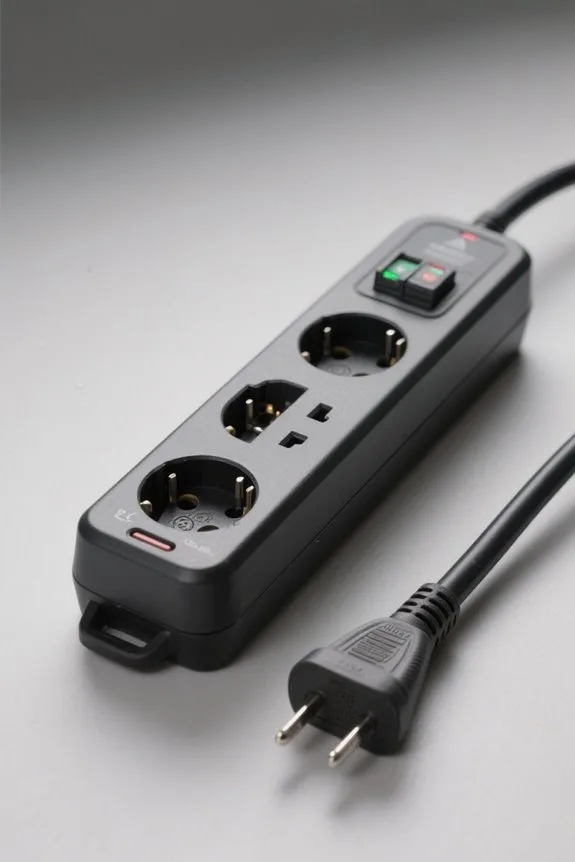
When using power strips, the operator must plug them directly into a wall outlet and never daisy-chain them to other strips or extension cords. The device should be UL listed, meeting UL 1449 for surge protection, and include a resettable circuit breaker rated 15 A, 1875 W. power strips and surge must not supply high-wattage appliances; do not connect microwaves (1000–1500 W) or refrigerators (600–1200 W). Use Extension Cords only for temporary, portable loads and never as a substitute for electrical outlets. The operator should match device wattage to strip rating, verify cord insulation, and inspect every 30 days. Surge protectors must be discarded if feeding damage, discoloration, or failure occurs. Follow manufacturer step-by-step setup and labeling instructions. Prefer surge protectors with 2000 J joule ratings for better multi-device protection.
Recommended Products
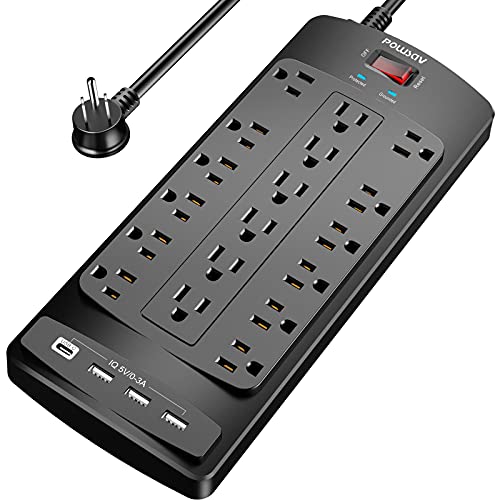
Power Strip with 18 outlets & 4 USB Ports: 18AC outlets & 4 USB ports, power strip with 6 feet Flat Plug Heavy Duty power extension cord, surge protector(2100 Joules) with overload protection protects against spikes and fluctuations,Lots of outlets for a computer desk works great for all the electronics a gamer needs.

MULTI-OUTLET SURGE PROTECTOR: Power everything on your desk with a single compact multi outlet extension cord; 12 AC outlets with surge protection charge your computer, laptop, phone, camera, etc.

6 OUTLET SURGE PROTECTOR — Six grounded, three prong outlets expand a single wall outlet into a centralized power solution for electronics, appliances and tools
OSHA and National Electrical Code Requirements
Following the proper use of power strips and surge protectors, operators must meet OSHA and National Electrical Code (NEC, NFPA 70) requirements for temporary extension-cord use. Operators should inspect Cords before use, looking for cuts, frays, or exposed conductors. Use cords rated for the equipment, for example 14 AWG, 15 A, 125 V for light-duty tools. Verify markings that show compliance with NEC Article 400 and OSHA regulations in 29 CFR 1910.301-.399. Route electrical cords so they do not run through doorways, windows, or walls, and secure them with cable protectors. Replace damaged cords immediately; do not splice or repair with tape. Avoid daisy chaining; this practice violates the National Electrical Code and OSHA regulations and raises fire risk. Document inspections weekly, retain records. Prefer cords with GFCI protection and confirm UL Listing for outdoor and heavy-duty cords.
Preventing Overloads and Daisy Chaining
Although daisy chaining may seem convenient, operators must avoid connecting power strips or extension cords together to prevent overloads and fires. Operators must prevent overloading by calculating load; sum device wattage and verify total stays below 1,800 watts. Recommended practice uses 15-amp circuits, 14 AWG copper wiring, and extension cords labeled EXT-14AWG or model EXC-140. Each power strip must plug directly into a wall outlet, matching strip rating PS-15A or higher circuit. Daisy chaining violates OSHA rules; remove chained strips, replace with individual outlets or a UL-listed rack mount. Inspect cords weekly for frayed insulation, exposed conductors, loose plugs, and burn marks, recording findings in log #FS-001. Maintain surge protection devices rated MOV-900 or SPD-120, replace after three years or after sustained surge events. Choose protectors with a surge protection rating of at least 1,200 joules for standard home use to improve safety.
Recommended Products

【8 IN 1 Power Strip】 - This surge protector with 5 widely outlets (1875W/15A) and 3 usb charging ports(Total 5V/3.1A) can power up 8 electrical devices simultaneously; Widely spaced outlets are separated enough to fit big adapters without blocking each other;is ideal for computer, TV and other household electrical devices

【12 IN 1 Power Strip & 2.2 IN Wide Space】- 3-side design power strip surge protector with 8AC widely outlets and 4 USB (2 USB C) charging ports can power up to 12 devices simultaneously. That makes it easier to make the plugs not covering any outlet, and the 2.2 inchces widely spced in between outlets, larger than standard socket, fit big adapters without blocking each other. The compact design saves more space, suitable for the home, office, and college dorm room essentials

★Multi Function Power Strip: Power strip surge protector with 12AC outlets & 4 USB charging ports, 6-foot Heavy Duty power extension cord, surge protector (2700 Joules)with overload protection protects against spikes and fluctuations.
Safe Outlet and Appliance Practices
After removing chained power strips and confirming surge device replacement, operators should plug major appliances directly into wall outlets rated for their load. Major appliances like refrigerators (120 V, 15 A) and stoves (240 V, 30 A) must not use the use of extension cords,power strips, or low-gauge cable. Install tamper-resistant outlets meeting UL 943 standards in homes with children, and fit GFCI outlets in moisture-prone rooms near sinks. Verify each outlet does not exceed its ampere rating, and label circuits with panel code markings such as 20A or 30A. Check that plugs fit snugly; replace loose sockets with device code 14-30R or 5-15R rated receptacles. If a trip occurs, reset the circuit breaker after reducing connected electrical equipment load. Follow rated loads precisely daily. When storing appliance documentation and wiring diagrams, use archival, acid-free tapes to prevent yellowing and deterioration over time.
Recommended Products

【Ultra Slim Design】Ultra-slim profile easily fits in electrical box and wall plate. Easy Installation with back or side wiring. Standard wall plate, screws and installation instructions included.

Designed to improve immunity for reduced High Frequency (HF) nuisance tripping. providing increased compatibility with appliances and other electronics

Provides continuous ground fault protection - detects and trips on actual ground fault even when self-test is being conducted
Inspection, Maintenance, and Compliance Tips
If operators inspect cords weekly, they can catch cuts, frayed wires, and exposed conductors before a failure leads to overheating. Perform monthly visual inspection for discoloration, softened insulation, and nicks over 2 mm along the conductor. Check power strips for resettable breakers and UL code markings such as UL1363 on the housing. Verify extension cords are UL-listed, rated 15 A or 20 A, labeled 14 AWG or 12 AWG. Remove and dispose of damaged units, cut cords to 4 inches, and seal ends to prevent reuse. Maintain compliance by recording inspection on form F-210, with date, inspector initials, defect code, and corrective action within 24 hours, annual review. Limit use to temporary needs under 90 days and confirm load does not exceed the nameplate wattage.
Recommended Products

EXPANDED POWER HUB – Three-outlet polarized extension cord in a clean white finish turns one indoor outlet into a centralized power source for electronics in your home, office, workshop or garage
![Power Cord Replacement Compatible with Sony Playstation3 PS3, Playstation4 PS4, Playstation2 PS2 Slim Edition Game Console, PSP, PSV - [UL Listed] 6FT Extension 2 Prong 18AWG Power Cord Cable Supply](https://m.media-amazon.com/images/I/41qx4CalTnL._SL500_.jpg)
REPLACEMENT AC POWER CORD for Sony Playstation2 PS2, Playstation3 PS3, Playstation4 PS4(Slim Edition); Sony PSP 1000 2000 3000; PSVITA 1000 2000; Microsoft Xbox One S Slim Game Console, Xbox One X ( check the power cord terminal or device interface as pictures )

ETL Listed and Trusted: 25 ft extension cord rated 13 Amps, 1625 Watts and 125 VAC; Male NEMA 5-15P and female NEMA 5-15R; It is ETL/cETL Listed; Ensuring its compliance with strict safety standards; Each outdoor extension cord passes a 2500V high voltage test before leaving the factory to ensure safety; Before use, please check the rated voltage, current, and power of the appliance to avoid exceeding 125V, 13A, and 1625W
Educational Resources, Handouts, and Outreach
Three basic resource types—printed handouts, accessible PDFs, and visual pictographs—should be used to teach proper extension cord and surge protector use. Educational resources list safety practices with step-by-step checks: measure cord length in inches, note 14 AWG or 16 AWG marking. Handouts specify that extension cords are temporary only, give product codes UL123456 and NEMA 5-15P for correct matches, plugging, labeling, testing. Accessible PDFs in English and Spanish must be under 300 KB, use 12-point sans-serif font, and follow WCAG 2.1 AA standards. Visual pictographs show do and don’t actions, avoid daisy-chaining, plug directly, and replace extension cords with frays over 1/4 inch. Outreach efforts use social media graphics sized 1080 by 1080 pixels, community talks, and handout packs of 50; you can distribute. Consider recommending clear storage options like clear drawers to improve visibility and organization.
Frequently Asked Questions
Is It a Fire Hazard to Plug an Extension Cord Into a Surge Protector?
Yes, it is a fire hazard: it violates extension cord safety, can exceed surge protector ratings, and increases electrical overload risks; observers recommend following proper usage guidelines, avoiding daisy-chaining, and using permanent wiring solutions instead.
Are Surge Protectors a Fire Hazard?
They can be a fire hazard if misused; surge protector safety depends on preventing electrical overload risks, following fire prevention tips, and observing appliance compatibility concerns, including avoiding daisy-chaining and overloaded high-wattage devices and regular inspections.
Is It Okay to Leave an Extension Cord Plugged in Overnight?
Like Icarus, it is not advisable to leave an extension cord plugged in overnight. One should follow safety guidelines and proper usage, check extension cord ratings, avoid overloads, and prioritize fire safety to prevent hazards.
What Makes an Extension Cord a Fire Hazard?
An extension cord becomes a fire hazard when improper wire gauge, excessive cord length, mismatched power rating, damaged insulation, daisy-chaining, or prolonged use cause overheating issues and exposed conductors leading to sparks, arcing, and ignition.