As an Amazon Associate, we earn from qualifying purchases. Some links on this site are affiliate links at no extra cost to you. Our recommendations are based on thorough research and editorial judgment.

When to Replace a Surge Protector

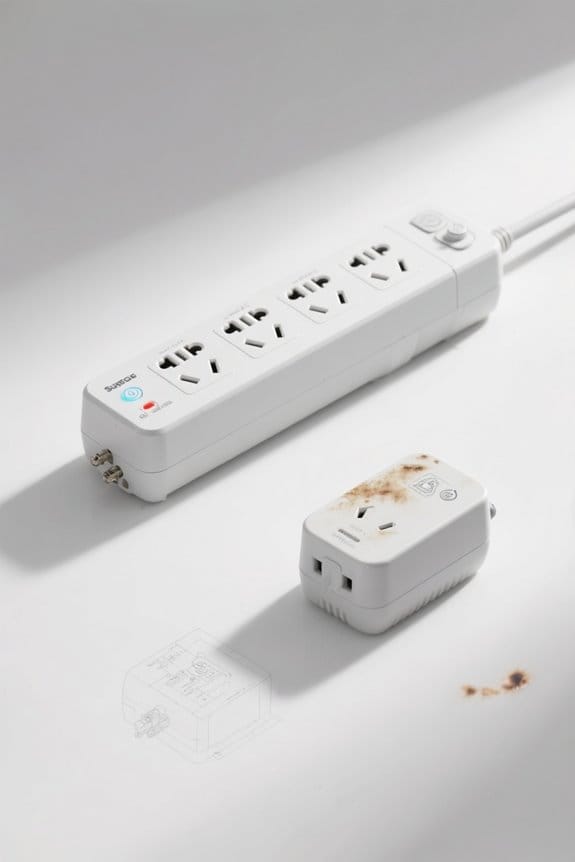
Surge protectors wear out as MOVs (e.g., MOV-14A) degrade and should be replaced every 3–5 years, or immediately after absorbing a ≥2,000‑joule surge. Inspect monthly for burn marks, cracks larger than 5 mm, frayed cords, or failed indicator lights. For replacement, unplug devices, remove unit, and install a UL1449-listed model rated ≥3,000 joules with automatic shutoff. Record model and serial numbers; promptly recycle old unit per e-waste rules. Continue for stepwise inspection and selection details.
Key Takeaways
- Replace every 3–5 years, sooner in storm-prone or unstable-grid areas.
- Replace immediately after a major surge or lightning strike, even if outward damage isn’t obvious.
- Replace if indicator lights fail, you smell burning, or you see cracks, discoloration, or melted plastic.
- Replace when the protector’s joule rating is likely exhausted or after repeated surges; track installation date and surge history.
- When replacing, choose UL1449-listed units with 2,000–3,000+ joules, indicator lights, and automatic shutoff.
Why Surge Protectors Wear Out
You may be interested
Because metal-oxide varistors (MOVs, e.g., MOV 14D471K) absorb transient voltage energy, they wear down after repeated surges and lose protection. Surge protectors wear through finite energy absorption and typical surge protector lifespan is three to five years. Frequent electrical surges, storms, or unstable grids accelerate degradation and reduce effective life expectancy markedly. Users should inspect for visible damage like burn marks, broken components, or failed indicator lights monthly, regularly. Measure joule rating on the label, for example 600 J, 1000 J, or 2000 J, to assess capacity. If indicator lights fail, visible damage exists, or measured joules fall below needs, replace surge protectors immediately following manufacturer steps. Store and operate units within manufacturer temperature ranges, typically -10°C to 40°C, and avoid high humidity environments. For workshop setups, consider using magnetic strips rated for at least 25 pounds to organize tools and keep the workspace orderly.
Average Lifespan of Common Surge Protectors
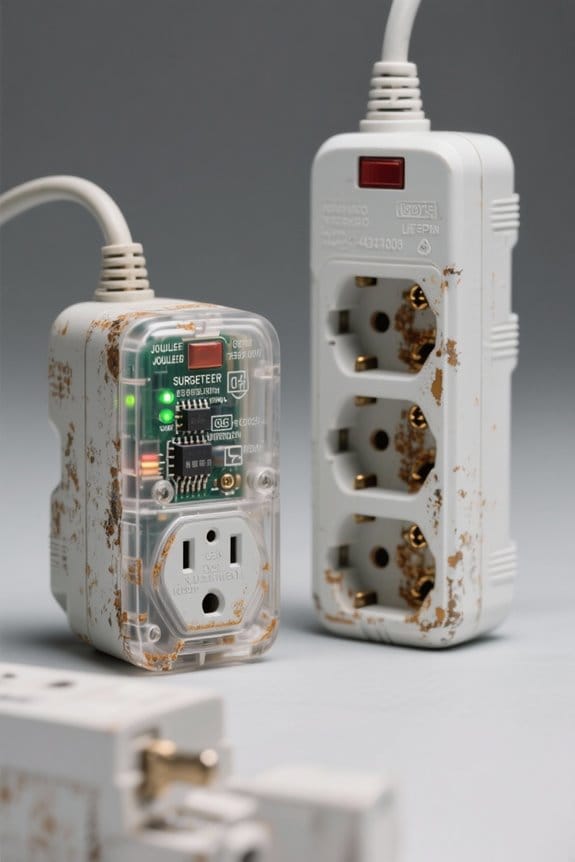
Although manufacturers often rate surge protectors for long service, most units last three to five years under typical household conditions. The average lifespan of common surge protectors is three to five years, with high-end models reaching up to ten years under ideal conditions. Frequent power surges or lightning strikes reduce effectiveness faster, especially when cumulative joules approach the device rating. Check the energy absorption capacity, often labeled as 3,000 J or higher; product code example SP-3000J or model SP-900J helps identification. Inspect annually and follow this step-by-step: 1) unplug load, 2) note device label and joules, 3) compare to expected surge history, 4) replace if below safety margin. Homeowners should routinely replace your surge protectors as preventative maintenance. Record dates and tester readings monthly. Heavy-duty constructions with moisture and oil resistance enhance usability in diverse climates.
Visible Signs of Damage to Watch For
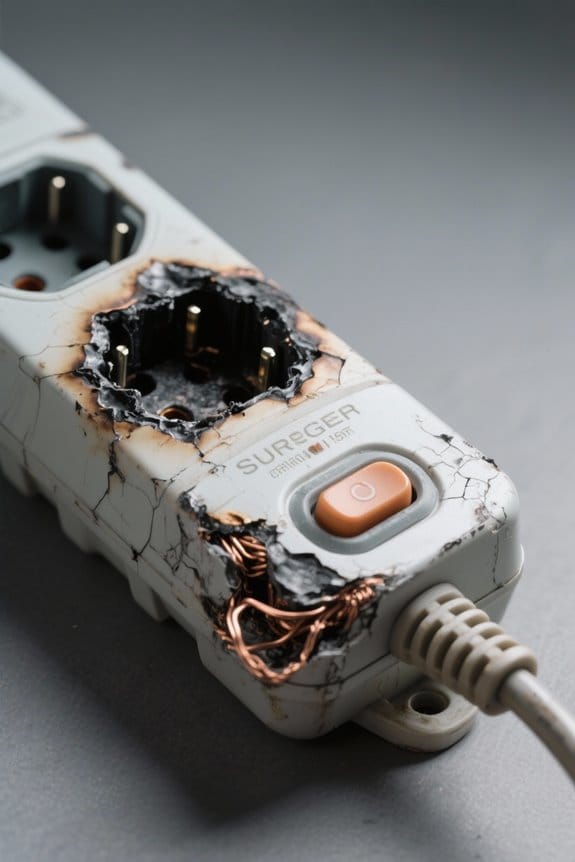
After noting the lifespan and joule rating, an inspection for visible damage should follow every 12 months. Inspect the surge protector casing for burn marks, cracks, melted plastic, or discoloration along seams and outlets. Measure any deformation; record dimensions in millimeters, for example a 5 mm crack length or larger, photo-tagged. Check for frayed wires, exposed conductors, loose plugs, and burnt odor; if found, the unit should be replaced immediately. Document product code and model, such as SP-2020 or PSR-350, and note serial numbers for warranty claims. Perform a visual checklist step-by-step: unplug, inspect, photograph, log findings, and tag units needing replacement with a date. Also examine indicator lights without testing functions, record their state, and remove any surge protector showing signs of damage. Also verify the joule rating clearly marked on the device to understand how much energy the protector can absorb.
Indicator Lights, Test Buttons, and What They Mean
When indicator lights or test buttons are present on a surge protector, they give clear, immediate status information about its protective circuits. Many models use green, amber, or red LEDs, where color change signals reduced protection and possible replacement needed. Test buttons, labeled “TEST” or code SPD-1000, let you perform a live check of the protective circuit functioning. Press and hold the button for 2 seconds, then observe the indicator lights; no response means you can plan replacement. Monitor for overheating by touching the case briefly, under 3 seconds, at a safe distance from prongs and cords. If lights are off, test button fails, SPD-1000 or model TRG-250 shows heat, disconnect immediately for safety and replacement. You can log date, code, and color daily. For reliable protection, choose surge protectors rated at 3000 joules or higher.

Offers 3,000 Joules of advanced surge protection for your coach. It features advanced circuit analysis to automatically shut off power in an emergency

30 amp Power Watchdog Smart Surge Protector offers 3,000 Joules of advanced surge protection for your coach. It features advanced circuit analysis to shut off power in an emergency and includes our patented Bluetooth connectivity so you can monitor live park power conditions on your smartphone using our free mobile app.

HEAVY DUTY aDesign: Right angle flat plug & flexible wall mount allows low profile, easy installation in tight spaces. WovenArmor Cable strength ensures quality performance. Ultra wide outlets allows space for bulky plugs
How Joule Ratings Relate to Longevity
Joule rating tells how much energy a surge protector can absorb before losing effectiveness, and you can use it to estimate expected lifespan. A 1,000–2,000 joule energy rating suits basic electronics such as TVs and routers. Devices rated above 2,500 joules suit high-value equipment like gaming PCs or servers. To assess longevity, note the joule rating on the label, model number (for example, SP-1000 or SP-2500), and installation date. Step 1: record the rating and date. Step 2: monitor indicator lights monthly. Step 3: replace the unit when the label shows damage or the protector fails a basic continuity test with a multimeter set to ohms. Remember, every protector has finite capacity and will lose surge protection after absorbing its rated joules, and replace. For example, some models like the Belkin offer 3,940 joules of protection suitable for many setups.
Effect of Frequent Power Surges and Stormy Weather
A surge protector in areas with unstable grids may degrade rapidly, sometimes failing within two to three years of service. Frequent power surges reduce component life and lower overall lifespan of surge protectors in measurable ways. Stormy weather raises the risk of lightning strikes, causing large transient currents that exhaust metal-oxide varistors and fuses. Inspect devices after storms, record date, measured joules, and model code such as SP-4000X or SPC-4200, replace when joules drop below 4,000 or indicator shows failure. For high-risk locations, select units rated above 4,000 joules and follow this step-by-step: 1) disconnect power, 2) verify voltage with meter, 3) replace unit, 4) test outlets. Regular checks prevent electronic losses from unmitigated power surges. Document each replacement with date and serial number for future reference immediately. For best protection in high-risk areas, consider surge protectors rated around 4320 joules to maximize device safety.
Whole-Home Surge Protection vs. Point-of-Use Units
How should homeowners choose between whole-home surge protection and point-of-use units based on measured surge risk and device needs? A whole-house surge protector at the main panel absorbs tens of thousands of joules, SPD-10000. Point-of-use units carry 1,000 to 4,500 joules, are portable, cheaper, because surge protectors go bad faster when surges occur. Estimate measured surge risk, if storms or unstable grids appear frequently, prioritize whole-house protection as the first line of defense. For critical electronics you can add point-of-use units labeled MOV and UL1449, model POU-3500, after installing a main SPD. Track the lifespan of your surge; whole-home units last five to ten years, point-of-use units three to five. If surge protector offers weaken, follow codes and schedule replacing surge protectors within recommended intervals. Consider choosing certified Type 2 SPDs for effective main-panel protection and compliance with NEC requirements.

Zero transfer time between on-line and battery modes for uninterrupted operation

.75kVA / 750VA / 600W line interactive 1U rackmount UPS, Sine wave output

2200VA/2200W Smart App Sinewave Battery Backup Uninterruptible Power Supply (UPS) System uses sine wave output to support Active PFC & conventional power supplies; Safeguards corporate and network servers, telecom installations, and VoIP systems
Inspecting and Maintaining Your Surge Protector
After installing a main SPD-10000 or adding a POU-3500 in key locations, regular inspection and maintenance keep protection working. Technicians should be inspecting surge protectors monthly for visible damage, such as 1 cm burn marks, melted components, or frayed wires. Remove power, then unplug the unit and wait 60 seconds before touching any metal contacts or internal components. Check indicator lights; if indicators are off or change color, the unit may need to be replaced. Keep the area clean, remove dust with a soft brush and vacuum nozzle within 10 cm of vents. Unplug surge protectors during severe storms or electrical fluctuations when possible to avoid overload and damage. Replace units that exceed three to five years or show any functional failure after inspection. Technicians should also confirm that connected cords and devices are UL-listed to ensure baseline safety.
Replacement After a Major Surge or Lightning Strike
When a major surge or lightning strike hits, technicians should replace the surge protector immediately to preserve device protection safely. After a surge, inspect for burnt marks, discoloration, or melted plastic within 10 cm of outlets, and note visible internal components damage carefully. Check joule rating, 2000 J and varistor codes like MOV-14A or MOV-20A, which indicate effectiveness, printed on the label also. If any component shows failure, perform replacement after a major surge without delay to avoid imminent further electrical damage to connected equipment. Follow manufacturer’s recommendations, including specific replacement intervals and post-event procedures in model guides, e.g., SP-1200 or SPC-900 series, documented. Remove power, disconnect cords, and install a new unit following grounding and torque specs of 2.5 Nm on terminal screws. Also consider models with ETL or UL certification and multiple layers of protection for added safety.


Designed for 24 volts DC electrical systems, such as trucks, RVS, ships, solar energy, etc.

Choosing a High-Quality Replacement Unit
Although installers may prioritize price, they should select units rated at 3,000 joules or higher, such as SPC-3000 or SPU-3500 models. Inspect surge protectors for a high joule rating, indicator lights, and automatic shutoff before purchase. Check dimensions: 12.0 in by 2.0 in by 1.0 in for typical rack models to confirm fit. Verify quality construction with UL1449 listing and flame-retardant ABS housing. Confirm warranty options, noting multi-year or lifetime coverage and claim limits in writing. Choose units with six outlets and two 2.4A USB ports for device versatility and better energy protection. To replace a unit, power down, unplug devices, remove old protector, and install new protector following label steps. You can test status lights after restoring power. Record purchase date and serial. Many modern surge protectors also include USB-C ports and a range of surge ratings (900–2700J) to support charging multiple devices safely.

Apc Smart-ups 3000 Va Tower/rack Mountable Ups - 3 Kva/2.70 Kw - 2u Tower/rack Mountable 6 Minute

APC Smart-UPS RT 3000VA Rack Tower 120V

3000VA/2400W power capacity; compact tower design; expandable battery backup
Safe Disposal and Recycling of Old Surge Protectors
Old surge protectors should be disposed of according to local electronic waste recycling rules because they may contain hazardous components. Municipalities offer designated recycling events and waste centers that accept surge protectors for safe disposal and onward recycling. Before recycling, the unit must be unplugged, confirmed nonfunctional, and any batteries removed following battery hazardous nature guidelines. Step 1: unplug the unit, wait 24 hours to dissipate residual charge, then document model and UL 1449 code. Step 2: package the unit in a 30×20×10 cm box, label with model, deliver to recycling. Retail take-back programs and some manufacturers accept old surge protectors for proper recycling and disposal locally. Follow municipal instructions for hazardous components, and verify compliance with electronic waste laws to avoid fines and contamination.
Frequently Asked Questions
How to Tell if a Surge Protector Needs to Be Replaced?
They determine replacement when surge protector indicators fail, visual inspection signs appear, performance degradation occurs, lifespan monitoring shows three to five years, power rating check fails, or connected device safety is compromised requiring immediate action.
How Often Should a Surge Protector Be Replaced?
Every three to five years, they are replaced like a weathered umbrella discarded after storms; surge protector lifespan hinges on voltage spikes, equipment protection needs, electrical safety tips, maintenance routines and industry standards adherence overall.
How Do You Know When a Surge Protector Expires?
A surge protector expires when its surge protector lifespan ends; indicator lights go out; visible physical damage appears; frequent plugging issues occur; internal electrical failures manifest; and manufacturer recommendations promptly advise immediate replacement be undertaken.
What Is the Average Cost of a Whole House Surge Protector?
It averages 300 to 1,500 dollars for the device, with 100 to 300 dollars in installation costs; whole house benefits, surge protector types, warranty considerations, maintenance tips, and electrical system compatibility influence price and selection.