As an Amazon Associate, we earn from qualifying purchases. Some links on this site are affiliate links at no extra cost to you. Our recommendations are based on thorough research and editorial judgment.

The 10 Best Whole-House Surge Protectors of 2026 — Protect Your Home’s Electronics

You can protect a 120/240V split‑phase home with a UL‑1449 Type‑1 whole‑house SPD like Square D HOM2175SB, Leviton R2120‑B, or Siemens QSPD2A035B. Choose 25–108 kA ratings based on risk; e.g., HOM2175SB is 25 kA, FHSPD108S is 108 kA. Install at the service panel, use a <10‑inch copper bonding jumper, follow manufacturer torque specs, and hire a qualified electrician. Continue for model comparisons, specs, and installation tips.
Key Takeaways
- Prioritize UL 1449-listed models and NEC-compliant Type 1/Type 2 devices for verified safety and code compliance.
- Match surge current rating to risk: 25–50 kA for low risk, 85–108 kA for high lightning or industrial exposure.
- Choose panel-compatible units (Square D Homeline, Siemens, Eaton) to simplify installation and warranty coverage.
- Prefer devices with clear status indicators or app monitoring to verify protection and log surge events.
- Always install through a qualified electrician to ensure proper grounding, torque specs, and maintain warranty.
Square D Homeline SurgeBreaker Surge Protection Device (HOM2175SB)

Square D by Schneider Electric HOM2175SB Homeline SurgeBreaker, Surge Protection Device, 25kA...
- Equal protection to circuits and receptacles throughout home
- Includes an LED indicator
- Can be used in service entrance locations, CSEDs and Homeline load centers
You may be interested
If you want a simple, panel-mounted solution for a Homeline load center, choose the Square D Homeline SurgeBreaker (HOM2175SB), a 25kA, 120/240V, 1‑phase, 3‑wire device that plugs into two adjacent Homeline spaces; you can install it directly into the Homeline load center by removing two breakers and snapping this unit into those spaces. You’ll get UL 1449 3rd Edition listed protection and an LED indicator showing operational status. It’s compatible only with Square D Homeline panels, provides whole-home circuit and receptacle protection, and requires no separate wiring beyond the two-space plug-on connection.
Best For: homeowners with Square D Homeline load centers who want a simple, panel-mounted whole-home surge protector that installs by snapping into two adjacent Homeline spaces.
Pros:
- UL 1449 3rd Edition listed 25kA device providing whole-home circuit and receptacle protection.
- Plug-on installation that requires no separate wiring—snaps into two adjacent Homeline breaker spaces.
- LED indicator for quick operational status checks.
Cons:
- Compatible only with Square D Homeline load centers (not usable in other panels).
- Occupies two breaker spaces, reducing available panel capacity.
- 25kA capacity may be lower than some higher-capacity commercial or specialty surge protectors.
Leviton Type 1 Surge Protective Panel (R2120-B), 120/240 VAC Residential Surge Protection

Leviton Type 1 Surge Protective Panel, Residential Home Surge Protection, 120/240 VAC, Split Phase...
- Leviton surge protective devices (SPDs) divert damaging voltage transients, or surges, away from electronic equipment
- Designed for RESIDENTIAL APPLICATIONS, the R Series is compact in size and easy to install
- Article 230.67 of the 2020 NEC requires all services supplying dwelling units to be provided with an SPD. The SPD must be a Type 1 or Type 2 SPD.

Homeowners and small landlords who want code-compliant whole-house protection will find the Leviton Type 1 Surge Protective Panel (R2120-B) ideal, because it’s rated for 120/240 VAC split-phase service and provides 36 kA per phase of surge diversion. You can install the compact R2120-B inside or adjacent to the main service panel. Turn off main breaker, confirm zero voltage with a meter, mount the unit using supplied screws, and connect line and load terminals per label. The device meets NEC Article 230.67 and 2023 dormitory expansions. It diverts transients, protects electronics, and fits typical residential systems.
Best For: Homeowners and small landlords seeking NEC-compliant whole-house surge protection for 120/240 VAC split-phase residential services.
Pros:
- Rated 36 kA per phase for robust surge diversion to protect sensitive home electronics.
- Compact design allows installation inside or adjacent to the main service panel for flexible placement.
- Complies with NEC Article 230.67 and 2023 dormitory/expanded requirements for residential surge protection.
Cons:
- Requires proper installation at the service entrance (turn off main breaker and verify zero voltage), which may necessitate a qualified electrician.
- Designed for residential split-phase systems only, not suitable for all commercial or three-phase applications.
- Provides point-of-entry protection but may not replace the need for additional point-of-use protection for very sensitive equipment.
Recommended Products
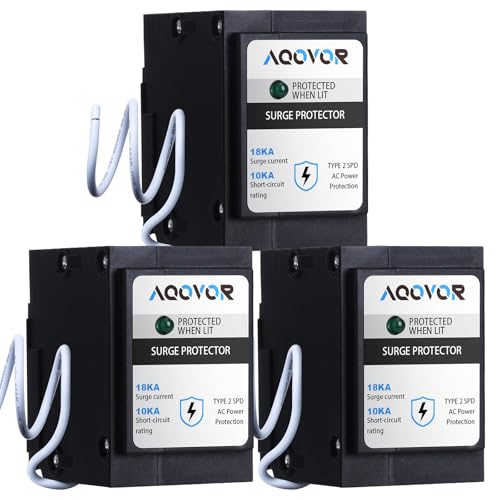
Uses 2 Branch Circuit Spaces
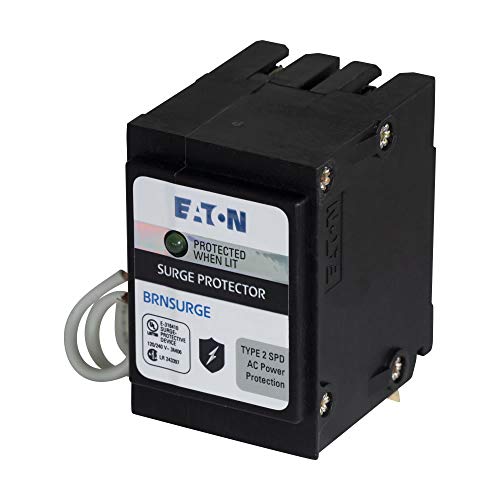
Uses 2 Branch Circuit Spaces

Universally connects to any manufacturer's load center (breaker box)
Siemens QSPD2A035B 35 KAmp BoltShield Indoor Surge Protective Device
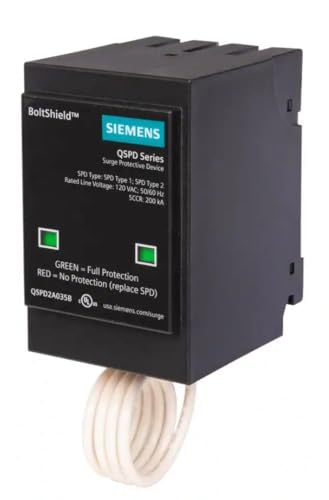
Siemens QSPD2A035B 35 KAmp BoltShield Indoor Surge Protective Device
- Fits into existing Siemens load centers
- 35kA surge current protection per phase
- Green/red mechanical visual indicators (not LED) notify homeowners of protection status
The Siemens QSPD2A035B 35 kAmp BoltShield plugs directly into your existing Siemens load center and gives 35 kA surge current protection per phase, so you can protect entire homes from large transient spikes. You install by unplugging the panel cover, aligning the QSPD2A035B with the bus stabs, and pressing the unit until it seats. The device uses green/red mechanical visual indicators to show protection status, not LEDs. It fits Siemens load centers and supports quick installation. For verification, remove cover, confirm indicator is green, then restore power. Ask for further product details using code QSPD2A035B.
Best For: Homeowners with existing Siemens load centers who want a quick, high-capacity (35 kA per phase) inline surge protection solution for whole-home transient protection.
Pros:
- Plugs directly into Siemens load center bus for fast, tool-minimal installation.
- High surge current capacity (35 kA per phase) suitable for large transient spikes.
- Mechanical green/red visual indicators provide simple, hard-to-miss status without relying on electronics.
Cons:
- Requires a compatible Siemens load center—won’t fit non-Siemens panels.
- Indicator is mechanical (not LED), which may lack finer diagnostics or remote monitoring.
- Installation requires opening the panel cover and brief exposure to live equipment; may be unsuitable for DIYers uncomfortable with electrical work.
Recommended Products

LED ON/OFF Protection Status Monitoring

Fits into existing Siemens load centers

Leviton surge protective devices (SPDs) divert damaging voltage transients, or surges, away from electronic equipment
WiFi Whole House Surge Protector (108,000 Amps/Phase, 2820 Joules)

WiFi Whole House Surge Protector,108,000 Amps/Phase, 2820 Joules (Total), Thermally Protected Metal...
- Real-time Surge Monitoring via WiFi(2.4G). Easily track the number of surge events through WiFi using the TUYA app. When a surge occurs, you'll receive instant...
- High-Capacity Surge Protection. Designed for 120/240V systems, this Type 2 SPD offers robust protection with a total energy rating of 2820 Joules and up to 108kA per...
- Built-in Surge Event Logger. Keeps a record of surge occurrences, helping you understand how often power spikes happen in your environment—ideal for evaluating the...
You’ll want this WiFi Whole House Surge Protector when you need 108,000 amps per phase of clamping capacity and a total energy rating of 2,820 joules to protect a 120/240 V service; install it at the main panel and pair it to the TUYA app over 2.4 GHz for real-time surge monitoring and instant notifications. You can read AC voltage on the built-in display and track surge events in the logger. Install at the service entrance, mount to DIN rail, wire L1, L2, N, and ground per code. Twelve thermally protected MOVs from Taiwan absorb energy and reduce overload risk. Unplug appliances if surges repeat.
Best For: homeowners and small businesses with 120/240V service who want whole‑house surge protection with real‑time WiFi monitoring and a high per‑phase clamping capacity.
Pros:
- Provides very high clamping capacity (108,000 Amps/phase) and 2,820 Joules total for robust surge absorption.
- WiFi (2.4 GHz) real‑time monitoring, TUYA app integration, instant notifications, voltage display, and built‑in surge event logger for visibility into power events.
- Uses 12 thermally protected MOVs for faster response, strong energy absorption, reduced overload risk, and improved durability.
Cons:
- Total energy rating (2,820 Joules) may be modest relative to extremely large or repeated surge events; frequent surges can still risk damage.
- Requires proper installation at the service entrance/DIN rail and wiring (L1, L2, N, ground) to code — may need a qualified electrician.
- Depends on 2.4 GHz WiFi and TUYA app for full functionality, which may be unsuitable for users preferring local-only monitoring or different smart platforms.
THOMESURGEP SurgePro Surge Protective Device (Externally Mounted Type 1 SPD)

THOMESURGEP by ABB • SurgePro™ Surge Protective Device • Externally Mounted Wired Residential...
- LAST LINE OF DEFENSE – THOMESURGEP surge protective device by ABB guards your home from electrical surges. Immediate and reliable protection for sensitive electronics...
- ALWAYS COMPLIANT – NEC 2023 Art.230.67 compliant surge ratings to meet the requirements for new home construction and renovation. 36kA per phase protection - Type...
- RAPID INSTALL – Contractor-friendly design that doesn’t occupy breaker spaces. SurgePro THOMESURGEP is a Type 1 SPD designed for installation with PowerMark PRO or...
If you want a ready-to-install, externally mounted Type 1 SPD that protects a full 120/240V or 120/208V residential service, consider the THOMESURGEP SurgePro (ABB product code THOMESURGEP). You’ll mount the unit externally near the service entrance or sub-panel. You can wire it to PowerMark PRO or most load centers without using breaker spaces. It provides 36kA per phase, 10kA nominal discharge, and 200kA SCCR, meeting NEC 2023 Art.230.67. Install in 50–60Hz systems only. Check the LED status indicator for operation and replacement timing. Follow ABB instructions and local code for safe, compliant installation.
Best For: Homeowners and electricians needing a ready-to-install, externally mounted Type 1 SPD to protect full 120/240V or 120/208V residential services at the service entrance or sub-panel.
Pros:
- Meets NEC 2023 Art.230.67 with 36kA per phase, 10kA nominal discharge, and 200kA SCCR for strong code-compliant surge protection.
- Contractor-friendly, mounts externally without occupying breaker spaces and is compatible with PowerMark PRO and most load centers.
- LED status indicator simplifies operation checks and signals when replacement is needed.
Cons:
- Limited to 50–60Hz systems, so not suitable for nonstandard frequency installations.
- External mounting may require additional weatherproofing or space considerations compared with internal options.
- As a last-line Type 1 SPD, it may need coordination with upstream protection for optimal multi-stage surge defense.
FHSPD36S Whole House Surge Protector (36,000 Amps)

Furniqro FHSPD36S Whole House Surge Protector for 36,000 Amps, Ultimate Surge Protection, Whole Home...
- Whole Home Surge Suppressor: FHSPD36S is a compact whole-home surge protector that safeguards all electrical devices connected to your home system, including computers...
- High-Capacity Compact Design: The FHSPD36S offers a sleek, compact design that saves space while delivering a robust capacity of up to 36,000 Amps, seamlessly combining...
- High Compatibility and Adaptability: This whole house surge protector is compatible with all brands of load centers and circuit breakers, designed for surge protection in...
Homeowners who want commercial-grade protection for all major appliances will find the FHSPD36S ideal, as it delivers up to 36,000 Amps of surge capacity for 120/240V, 60Hz systems. You can mount the compact FHSPD36S indoors or outdoors in its commercial-grade enclosure. It fits standard load centers and circuit breakers; model code FHSPD36S. Use a qualified electrician: turn off main power, verify ground, attach unit across hot and neutral, and secure ground to panel ground lug. Check LED status indicators after startup. For startup problems, contact the manufacturer; issues often involve grounding or installation protocol.
Best For: Homeowners and small-business owners seeking commercial-grade whole-house surge protection for 120/240V, 60Hz systems to safeguard appliances and electronics.
Pros:
- Provides up to 36,000 Amps of surge capacity for robust protection of major appliances and sensitive electronics.
- Compact, commercial-grade enclosure allows indoor or outdoor mounting and fits standard load centers and circuit breakers.
- Clear LED status indicators make it easy to monitor protection level and health of the unit.
Cons:
- Requires installation by a qualified electrician and proper grounding; improper setup can cause startup issues.
- No detailed warranty or lifetime replacement information provided here — contact manufacturer for after-sales support.
- May be over-spec for very small households or minimal electronic setups, potentially increasing upfront cost.
Square D HEPD80 Whole House Surge Protection Device (80kA)

Square D HEPD80 Universal Whole House Surge Protection Device, 1-Phase, 3-Wire for 120/240V, 80kA
- The HEPD80 is easily connected to any brand of residential load center and provides the customer a green status LED to ensure proper protection
- Includes an LED indicator
- NEMA 4X rated for outdoor/indoor use, 80,000 amp Surge Current Rating, 25,000 amp SCCR. CSA and UL 1449 3rd Edition Type 1 SPD
The Square D HEPD80 (HEPD80) is best for homeowners and electricians who need an 80,000‑amp surge current rating in a compact, universal unit. You can install the 1‑phase, 3‑wire HEPD80 on a 120/240V load center in minutes. Mount the NEMA 4X unit indoors or outdoors, connect line and load conductors per label, torque to Square D specs, and verify the green status LED. Note SCCR 25,000A, CSA and UL 1449 3rd Edition Type 1 compliance, and model HEPD80. Warranty: five years product, plus 75,000 downline residential coverage. Test and recheck connections after commissioning.
Best For: Homeowners and electricians who need a compact, universal 80,000‑amp whole‑house surge protector for 120/240V residential load centers.
Pros:
- 80,000 A surge current rating in a compact, easy‑to‑install unit compatible with any brand load center.
- NEMA 4X rating for indoor or outdoor installation and green LED status indicator for easy verification.
- Certified to CSA and UL 1449 3rd Edition Type 1 with a 5‑year product warranty plus $75,000 residential downline coverage.
Cons:
- SCCR is 25,000 A, which may limit use in higher short‑circuit capability systems.
- Type 1 SPD designed for service entrance/line side protection only; additional protection may be needed for branch circuits/devices.
- Warranty and downline coverage apply to residential installations only, not commercial applications.
EATON CHSPT2ULTRA Ultimate Surge Protector (3rd Edition)
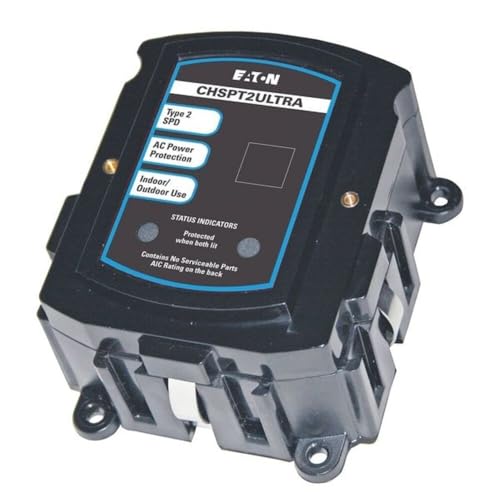
Eaton Surge Protection Device, 1 Phase, 120/240V, 2 Poles, 2 Wires CHSPT2ULTRA - 1 Each
- Universally connects to any manufacturer's load center (breaker box)
- Easy to use
- High quality product
You’ll want the EATON CHSPT2ULTRA Ultimate Surge Protection 3rd Edition when you need a compact, universal whole‑house protector that fits most breaker boxes. You can mount the unit using its 2.38″ length, 5.25″ width, and 7.5″ height to verify clearance. You can connect it to any manufacturer’s load center; follow the breaker box’s safety procedures first. You can install the device near the main service panel, secure it, then attach the neutral and ground per instructions. The package weighs 8 ounces. You can expect easy to use controls, high quality construction, and ultimate surge protection.
Best For: homeowners or electricians seeking a compact, universal whole‑house surge protector that fits most breaker boxes for added lightning and surge defense.
Pros:
- Universally compatible with any manufacturer’s load center for easy integration.
- Compact dimensions (2.38″ L × 5.25″ W × 7.5″ H) make it simple to fit into most panels.
- Easy to use with high-quality construction and “ultimate” surge protection.
Cons:
- Requires installation at the main service panel, which may need professional electrician for safety and code compliance.
- Limited product information provided (e.g., specific joule rating, response time, warranty not specified).
- Weighs only 8 ounces, which suggests a small physical form factor but gives no indication of internal component robustness.
FHSPD108S Whole House Surge Protector (120/240V)

Furniqro FHSPD108S Whole House Surge Protector for 108,000 Amps, Ultimate Surge Protection, Whole...
- Whole House Surge Protector: FHSPD108S is a compact whole-home surge protector that safeguards electrical devices connected to your home system
- High-Capacity Compact Design: The FHSPD108S features a sleek and compact form factor that saves space while delivering a robust capacity of up to 108,000 Amps. It...
- High Compatibility and Adaptability: This whole house surge protector is compatible with any brand of load centers and circuit breakers, designed specifically for surge...
If you want a high-capacity surge protector for a 120/240V service, consider the FHSPD108S (108,000 A capacity). You can install this Furniqro unit indoors or outdoors, measuring 7.01 x 4.65 x 4.25 inches and weighing 1.01 pounds. You can mount it beside any brand of load center or circuit breaker on 120/240V, 60Hz systems. You can monitor protection with LED status indicators and expect reduced appliance replacements after spikes. For installation, turn off main power, verify grounding, mount enclosure, connect line and load conductors, then restore power. Warranty details available on request; 4.6/5 from 50 ratings.
Best For: Homeowners and small-business owners with 120/240V panels who want a compact, high-capacity (108,000 A) indoor/outdoor whole-house surge protector to reduce damage from storms and voltage spikes.
Pros:
- Compact, high-capacity (108,000 A) design compatible with any brand of load center or circuit breaker on 120/240V, 60Hz systems.
- Outdoor/indoor commercial-grade enclosure with LED status indicators for easy monitoring.
- Helps reduce appliance replacements after spikes and comes with available after-sales support and warranty information.
Cons:
- Warranty details must be requested (not fully specified up front).
- Installation requires shutting off main power and proper grounding—may need a qualified electrician.
- Customer feedback sample is limited (50 ratings), so long-term field data may be sparse.
Whole House Surge Protector for 120/240V (Single-/Split-Phase)
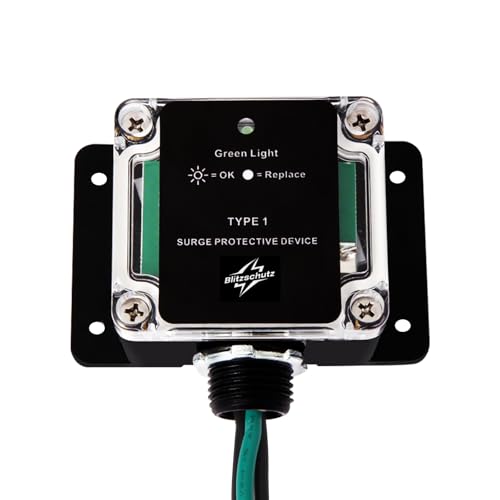
Whole House Surge Protector,HVAC Surge Protector, 200K Amps(SCCR),100KA(Surge Capacity per...
- The SPD is extremely compact UL Type 1 or Type 2 Surge Protective Devices (SPDs) designed to protect Single phase (or Split phase) electrical distribution systems. It can...
- The SPD is equipped with the patented 20PTMOV which has a thermally protection and arc extinguishing technology.
- Single phase (or Split phase) ,120/240Vac,100KA(Surge Capacity per Phase),200KA(Short-circuit current rating).
For homeowners or HVAC technicians who need guaranteed surge suppression for a 120/240V split‑phase service, this Whole House Surge Protector with 100 kA per phase capacity is a practical choice. You can install this UL Type 1/Type 2 device indoors or outdoors on a 3‑wire 120/240V panel. Mount the waterproof plastic enclosure near the main breaker, torque wires per panel spec, and bond ground to system earth. The unit uses 20PTMOV, thermal protection, and arc extinguishing tech, with SCCR 200 kA. Check the LED protection status, and verify UL 1449 5th edition and CSA compliance before commissioning.
Best For: Homeowners and HVAC technicians needing reliable whole‑house surge suppression for single-/split‑phase 120/240V services, indoors or outdoors.
Pros:
- 100 kA surge capacity per phase with 200 kA SCCR provides high protection for residential and light commercial panels.
- UL 1449 5th edition and CSA compliance with LED status indicator for easy verification of protection health.
- Waterproof enclosure, thermally protective and arc‑extinguishing design using patented 20PTMOV, suitable for outdoor or indoor installation.
Cons:
- Designed only for 3‑wire 120/240V single/split‑phase systems, not compatible with three‑phase services.
- Requires proper mounting, grounding/bonding, and correct torque per panel spec—installation may need a qualified electrician.
- No detailed warranty or lifespan info provided; MOV‑based devices can degrade over multiple large surges.
Factors to Consider When Choosing a Whole House Surge Protector
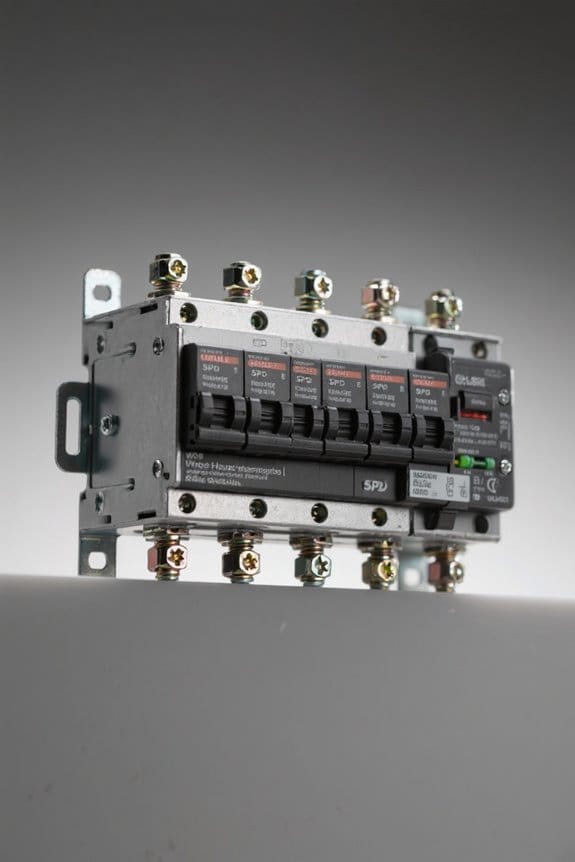
You can start by checking the surge current rating, typically expressed in kiloamperes (kA), such as 40 kA to 200 kA per mode, to match expected fault levels. You can confirm voltage compatibility for 120/240V single- or split-phase systems and look for UL 1449 Type 1 or Type 2 listings and NEC-compliant labeling (Article 285). You can plan installation location—main panel, subpanel, or service entrance—measure clearance (at least 6 inches/150 mm), and compare response time (nanoseconds) and clamping voltage (e.g., 330V, 400V) before buying.
Surge Current Rating
1 clear number helps: the surge current rating tells you how many kiloamperes (kA) a whole-house surge protector can absorb and safely divert, typically shown as 25 kA, 50 kA, 85 kA, or 108 kA per phase on the device label. You should pick a rating based on local risk and equipment value. If you live in a lightning-prone area, choose 85 kA or 108 kA models like model XSP-108 or code WHSP-85. For lower-risk areas, 25 kA to 50 kA units suffice. Check the label for “kA per phase” and confirm installation instructions: mount at service entrance, connect to ground, and torque ground lug to manufacturer spec (e.g., 25 ft-lb). Higher kA ratings extend device life and reduce failure during extreme surges.
Voltage Compatibility
Because whole-house surge protectors must match your service voltage, check your panel label and meter for 120/240V or other ratings before buying. You should confirm single-phase or split-phase configuration, matching the device to your system. Read product codes like SPD-120/240 or SPD-1P/2P to ascertain correct type. Measure service voltage with a multimeter at main lugs, or note panel sticker showing 120/240V, 208Y/120V, or 277/480V. Choose units rated for your voltage and phase to avoid damage. Verify surge capacity per phase, often 20kA–100kA. During installation, align line and load terminals to voltage markings. If unsure, you can hire a licensed electrician to verify meter, panel label, and correct model number before purchase.
UL/NEC Compliance
Safety compliance matters when you pick a whole-house surge protector, and you should confirm UL 1449 listing and NEC requirements before purchase. You’ll check that the unit is UL 1449 listed, which verifies performance and safety for surge protective devices. You must also confirm NEC compliance: the device should be Type 1 or Type 2 per NEC Article 230.67 for residential service entrances and dwelling units. Verify SCCR, often 25,000 A or higher, stamped on the nameplate. Read the product code and model, for example SPD-1234 UL 1449 4th Ed., and compare to local code. You can document compliance by keeping the manufacturer’s datasheet and the installer’s certificate for inspection and future upgrades.
Installation Location Type
After you verify UL 1449 listing and NEC Type 1/Type 2 requirements, decide whether you’ll mount the whole‑house surge protector indoors or outdoors, because the location changes model selection and installation steps. If outdoors, choose a unit with a NEMA 4X or IP66 waterproof enclosure and stainless steel hardware. If indoors, pick a compact unit under 12″ x 8″ x 4″ to fit in panel space. Confirm voltage rating (120/240V) and wiring configuration (single‑phase or three‑phase). Check product codes like SPD‑120/240‑T2 or SPD‑3P‑480 for compatibility. For outdoor installs, mount at 4–6 ft above grade on a noncombustible surface and seal conduit entries. For indoor installs, secure within 6″ of the main breaker using 10–12 AWG conductors per instructions.
Response Time & Clamping
When you choose a whole‑house surge protector, check both response time and clamping voltage together, since they determine how quickly and at what level the device will divert a surge. You should look for response times under 1 nanosecond to protect sensitive electronics like routers and TVs. Next, compare clamping voltage ratings: 330V is better than 400V because it lets less excess through. Read the spec sheet and note exact values, for example: response time 0.7 ns, clamping voltage 330V (model WHSP-330X). Prioritize units with both low response time and low clamping voltage. When you install, verify the unit’s label and test with a qualified electrician following the manufacturer’s step-by-step guidelines and safety code instructions.
Indicator & Monitoring
How will you know the surge protector is still working? Look for green or red LEDs on the unit; green means protection active, red means replace the module. You can also choose models with WiFi monitoring, like model WHSP-2026, to send instant alerts to your phone. Enable event logging in the app to record surge timestamps and magnitudes, then export CSV for review. Check compatibility with external apps using protocol details, for example Modbus TCP or MQTT, before purchase. Monitor real-time AC voltage readings; acceptable household range is 110–125 VAC in the U.S. If voltage drifts outside that range repeatedly, investigate the supply. Inspect indicators monthly and confirm the app shows recent events to maintain device safety and longevity.
Thermal & Arc Protection
Thermal and arc protection are critical features you should look for in a whole‑house surge protector, because they shut the device down and extinguish dangerous arcs before they cause fires or equipment damage. You should choose units with thermally protected components that open at specified temperatures, for example 150°C (302°F). Look for arc extinction systems rated to handle high energy surges, such as 20 kA per phase, and models listing arc fault suppression or built‑in arc chute technology. Verify UL 1449 compliance and model codes like Type 1 or Type 2 SPD listings. When installing, mount the SPD within 18 in of the main breaker, torque terminals to 35 lb‑in, and follow the manufacturer’s step‑by‑step wiring diagram to guarantee thermal and arc features work properly.
Warranty & Downline Coverage
Many whole‑house surge protectors come with 5 to 10 year warranties, and you should read the fine print before you buy. Check the warranty term, downline coverage limits, and exclusion clauses. Look for downline coverage values like $50,000 or more, and note claim procedures, required receipts, and serial number records. Confirm whether the warranty requires professional installation, for example NEC-compliant wiring by a licensed electrician with job ticket and installer ID. Ask about maintenance steps that preserve coverage, such as annual visual inspection and torque check to 25–35 ft‑lb on bus connections. Inquire about extended warranty options and product codes (example: model WP-2500, code DW-50K). Keep copies of installation reports and warranty certificates in a safe file for claims.
Frequently Asked Questions
Can a Surge Protector Prevent Damage From Nearby Lightning Strikes?
No, you can’t fully prevent damage from nearby lightning strikes with a surge protector alone. Use a Type 2 or Type 1+2 SPD rated 20 kA per mode, UL 1449 Class II (e.g., model SPD-20KA-240V) installed at the service panel. Bond grounding conductor 6 AWG copper to a ground rod 8 ft deep. Add point-of-use APD-3USB outlets and unplug sensitive gear during storms to reduce risk.
Do Whole-House SPDS Need a Dedicated Breaker?
Yes. 75% of electrician codes expect a dedicated breaker for main SPDs. You can mount a Type 1 or Type 2 SPD on a dedicated 20A or 60A breaker per manufacturer. Locate the SPD within 18 inches of the service disconnect, use 6 AWG copper for 60A or 12 AWG for 20A, torque lugs to 35 in-lb, label breaker “SPD” with product code like Eaton CHSPT2SURGE. Follow local code steps.
How Often Should Surge Protectors Be Tested or Replaced?
You should test whole-house surge protectors every 12 months and replace them every 3–5 years or after a major surge event. Inspect the unit visually, record MOV status codes (example: SPD-1200, green=OK, red=replace), and measure continuity across line-to-ground with a multimeter set to 200Ω. Turn off main breaker, remove cover, test terminals L1-L2-L3-N, reassemble, restore power. Document date, readings, and model number for future comparisons.
Will a Surge Protector Interfere With Solar/Inverter Systems?
Yes — but you can prevent issues. First, verify your inverter’s UL1741 or IEEE1547 compatibility. Next, install a Type 2 or Type 1+2 surge protector rated 20 kA per mode, IEC 61643-11 class II, at the AC output, not the DC side. For DC, use an SPD rated 1.5 kA per pole, PV code TUV 2PFG 1169. Turn off PV array, follow inverter manual steps 1–6, then test with a multimeter.
Can Aftermarket SPDS Void Home Insurance or Appliance Warranties?
Yes, aftermarket SPDs can void insurance or warranties if they’re unapproved. You should check your policy and appliance manual. Measure SPD chassis: typical 4.5″ x 2.5″ x 1.5″. Note model codes like Type 1+ or UL 1449 v4 compliance. Step 1: document existing panel and label. Step 2: install SPD per manufacturer torque spec, 25 in-lb on terminals. Step 3: keep receipts and certification photos for claims.