As an Amazon Associate, we earn from qualifying purchases. Some links on this site are affiliate links at no extra cost to you. Our recommendations are based on thorough research and editorial judgment.

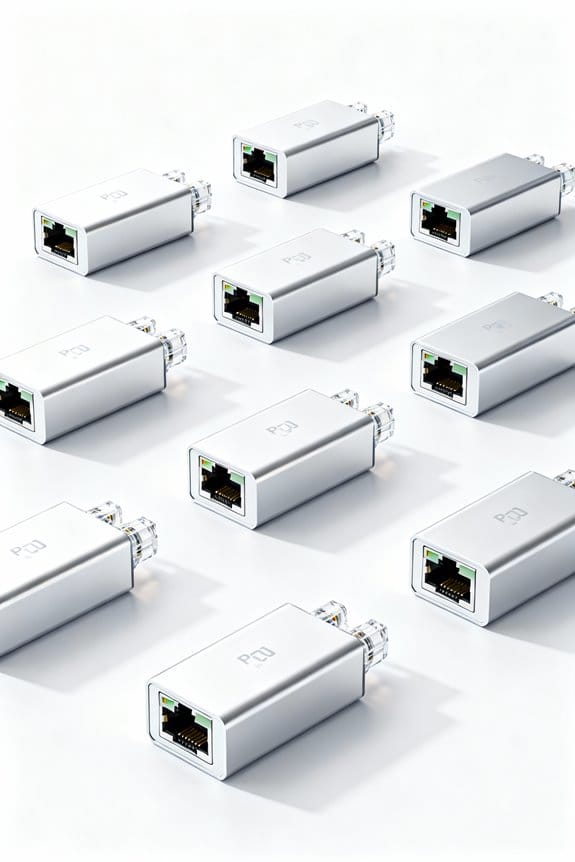
10 Best PoE Surge Protectors to Safeguard Your Network (2026 Buyers’ Guide)

You can protect Gigabit PoE devices with surge protectors like TP302 (supports 154W at 48V, 20KA 8/20µs) or PROCET PT-PR04G (120W per port, common-mode >20KV). Install inline between cable and device, bond to earth with ≤5 Ω ground using 12AWG wire, and verify continuity. For outdoor use choose GDT/TVS combos (5–10KV, 5–20kA) and weatherproof mounts. Below you’ll find model specs, wiring steps, and compatibility checks.
Key Takeaways
- Match the surge protector’s PoE power rating (e.g., 30W PoE+, 60–90W PoE++) to your device’s wattage.
- Choose protection technology (GDT, TVS, MOV) and surge current rating (10–20kA+) based on lightning exposure.
- Ensure full Gigabit (1000 Mbps) compatibility and low insertion loss for network performance.
- Verify grounding requirements and aim for a solid earth bond under 5 ohms for effective suppression.
- Prefer outdoor-rated, weatherproof housings and proper mounting options for exposed installations.
Ethernet Surge Protector (10 Pack) for Gigabit PoE++ LAN (RJ45)

Ethernet Surge Protector (10 Pack) Gigabit PoE++ 154W/3.2A -Mounting Flange (Gas Discharge Tube...
- (10 Pack) Ethernet Surge Protector for Gigabit GbE PoE/High PoE++ (HPoE) 1000 Mbps LAN Ethernet Network
- Gas Discharge Tubes for Full Protection GDT - Lightning Suppressor RJ45 Cable Protection CAT6/CAT5
- Aluminum Case,Ground Wire 12AWG,Line-Line Line-Ground Protection,Bidirectional Clamping,20KA 8/20μs
You may be interested
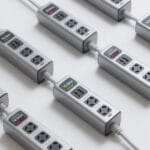
If you need robust surge protection for Gigabit PoE++ devices, choose the Tupavco TP302 Ethernet Surge Protector (10 pack), which supports 154W at 48V and 3.2A over four pairs. You’ll mount the aluminum-case TP302 inline with CAT5/CAT6 cables using RJ45 connectors. You can ground it with the included 12AWG ground wire to a verified earth point. The unit uses gas discharge tubes for line-line and line-ground protection, bidirectional clamping rated 20KA 8/20μs. It meets IEEE 802.3 af/at/bt, transmits 1000 Mbps, and protects routers, modems, cameras, and switches. Install one per cable run.
Best For: Network installers and IT/AV professionals needing inline surge protection for Gigabit PoE++ devices (cameras, switches, routers) that require up to 154W/48V and 1Gbps data throughput.
Pros:
- Supports Gigabit speeds (1000 Mbps) and IEEE 802.3 af/at/bt PoE standards, including PoE++ up to 154W/48V (3.2A on 4 pairs).
- Robust transient protection with gas discharge tubes and bidirectional 20kA (8/20µs) clamping, plus durable aluminum housing.
- Includes 12AWG ground wire for secure grounding and is compatible with CAT5/CAT6 inline RJ45 installations.
Cons:
- Adds an inline component per cable run, which may complicate installations and require additional RJ45 terminations.
- May not protect against all types of indirect lightning damage or very high-energy surges beyond its 20kA rating.
- Requires a verified earth ground connection to achieve full protection effectiveness; performance limited if grounding is poor.
Recommended Products

【Surge Protection】:Ethernet surge protector is designed to protect equipment against transients from lightning, ESD, and ground surges. Awishwell surge protector supports speeds up to 1 Gigabit -1000 Mbps, and provides PoE++ 802.3af/at/bt compatibility with 10KV surge protection, without affecting network performance. Peak surge current protection up to standard 20KA 8/20μs.

Ethernet Surge Protector for Gigabit GbE PoE/High PoE++ (HPoE) 1000 Mbps LAN Ethernet Network

PROTECTION EQUIPMENT - The Network Surge Protector Suppressors protects against network surges.Insert a Network Surge Protector in your network cables, to prevent network surging.This is a good insurance policy for your expensive router and outdoor POE antenna.
Ethernet Surge Protector Gigabit RJ45 Lightning Arrestor (PoE++ 1000Mbps)
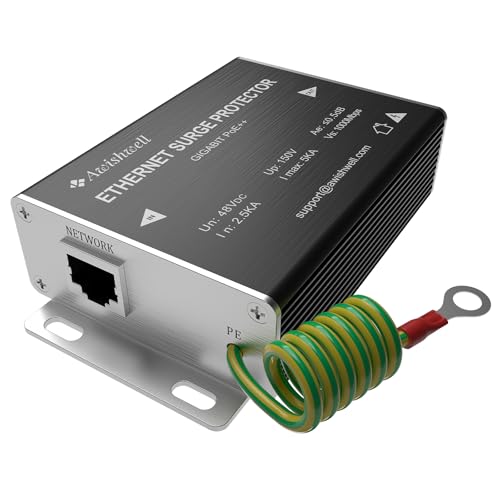
Awishwell Ethernet Surge Protector Gigabit, Ethernet Lightning Arrestor PoE++ 802.3af/at/bt-RJ...
- 【Surge Protection】: Ethernet surge protector is designed to protect equipment against transients from lightning, ESD, and ground surges. Awishwell surge protector...
- 【Performance Support】: Our Ethernet Lightning Arrestor provides 8-wire line protection; response time ≤ 1ns; insertion loss (Ae) ≤ 0.5dB; operating voltage (Un...
- 【Structural Performance:】: The aluminum housing offers excellent corrosion resistance, heat dissipation, and mechanical strength. Equipped with internal PTC...
You’ll want this Ethernet Surge Protector Gigabit RJ45 Lightning Arrestor (PoE++ 1000Mbps) when you need 1 Gbps PoE protection for cameras, switches, or routers at exposed sites. You can install it inline, connecting IN to the incoming cable and OUT to the protected device. It supports PoE++ 802.3af/at/bt at 1000 Mbps with 3KV protection and 5KA peak 8/20μs. The unit uses 8-wire protection, response ≤1ns, insertion loss ≤0.5dB, Un 48V DC, Uc 75V DC. It has aluminum housing, internal PTC, GDT, 15AWG 11.81-inch ground wire, and dual flanges.
Best For: Protecting outdoor or exposed-site network devices (IP cameras, PoE switches, routers) that require 1 Gbps PoE++ protection from lightning-induced surges and voltage transients.
Pros:
- Supports full Gigabit speeds with PoE++ (802.3af/at/bt) while providing 3KV surge protection and up to 5KA peak 8/20µs current handling.
- 8-wire protection with ≤1 ns response and ≤0.5 dB insertion loss preserves network performance.
- Robust construction: aluminum housing, internal PTC for auto-recovery, GDT for surge diversion, plus a 15 AWG ground lead and wall-mount flanges for easy installation.
Cons:
- Maximum continuous operating voltage (Uc) of 75 V DC may not suit unconventional higher-voltage systems.
- Requires proper grounding (ground wire and correct installation) — effectiveness depends on site grounding quality.
- Mounting screws not included and external placement may still expose unit to extreme weather without additional enclosure.
Recommended Products

(2 Pack) Ethernet Surge Protector for Gigabit GbE PoE/High PoE++ (HPoE) 1000 Mbps LAN Ethernet Network

Ethernet surge protector with 1000 Mbps and PoE++ compitability - won't slow your network down

Gas Discharge Tubes(GDT) and Transient Voltage Suppressor(TVS) provide dual protection.
PROCET Ethernet Surge Protector Gigabit (PT-PR04G)

PROCET Ethernet Surge Protector Gigabit - 4 Pairs Port 20KV Industrial Lightning Arrestor for -40°F...
- 【PoE Surge Protection】The common mode surge voltage exceeds 20KV(10/700us) and the differential mode surge voltage is 1.5KV(10/700us).
- 【Specifications】4 pairs Port POE Surge Protector, supports up to 120W power per port, maximum input voltage of 60V DC, and supports data speeds of 10/100/1000 Mbps.
- 【Versatile PT-PR04G】Compatible with IEEE802.3af/at/bt or PoE++ standard devices and non-standard Ethernet equipment, providing effective surge protection for your...
For network installers and facility managers who need high-capacity PoE protection, the PROCET PT-PR04G is a 4-pair Gigabit surge protector built for devices that draw up to 120W per port. You can protect four twisted-pair Ethernet lines using GDT technology. Install on DIN rail or mount on a wall or desk using the flexible bracket. Connect input and output RJ45, confirm maximum input voltage is below 60V DC, and verify IEEE802.3af/at/bt or PoE++ compatibility. It withstands common mode surges exceeding 20KV (10/700µs) and differential surges of 1.5KV (10/700µs). Operating range: -40°C to 85°C.
Best For: Network installers and facility managers needing high-capacity PoE surge protection for Gigabit Ethernet devices drawing up to 120W per port in industrial or commercial environments.
Pros:
- Uses GDT technology to protect four 4-pair Ethernet lines with common-mode surge resistance exceeding 20kV (10/700µs).
- Supports Gigabit speeds (10/100/1000 Mbps) and IEEE802.3af/at/bt / PoE++ devices up to 120W per port.
- Durable zinc-alloy housing and flexible DIN-rail / wall / desk mounting for versatile installation in harsh environments.
Cons:
- Differential surge protection is limited to 1.5kV (10/700µs), which may be insufficient for some extreme surge events.
- Maximum input voltage capped at 60V DC, requiring verification before use with higher-voltage systems.
- No mention of indicator/status LEDs or alarm output for surge/fault conditions, which limits monitoring capability.
Recommended Products
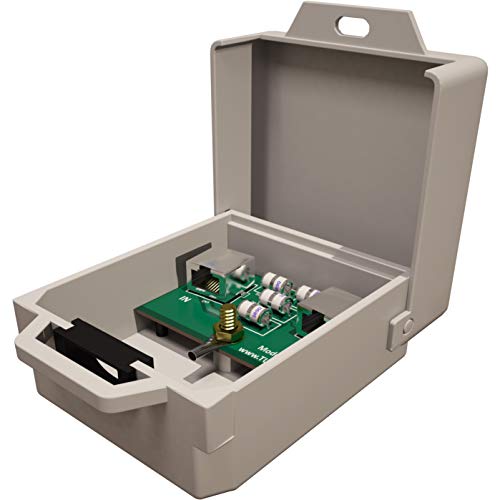
Outdoor Ethernet Surge protector for gigabit GbE PoE/high PoE+ (HPoE) 1000 Mbps LAN Ethernet network

🛡️ PROTECTS single port-to-port RJ45 Modem, Router, Switch, Patch Panel, Security Camera, CCTV, VoIP, WiFi Access Point, Computer, Gaming Console, NAS drive, TV, AV connections. 1 nanosecond surge detection time.

【PoE Surge Protection】The common mode surge voltage exceeds 20KV(10/700us) and the differential mode surge voltage is 6KV(10/700us).
Tupavco TP303 Ethernet Surge Protector for Outdoor PoE+ Gigabit Networks

Tupavco TP303 Ethernet Surge Protector Outdoor for PoE+ Gigabit 1000Mbs - LAN Network Thunder...
- Outdoor Ethernet Surge protector for gigabit GbE PoE/high PoE+ (HPoE) 1000 Mbps LAN Ethernet network
- Gas discharge tubes for full protection GDT - Lightning Suppressor RJ45 cable protection Cat6/Cat5
- Outside use weater resistant - line-line line-ground protection, bidirectional clamping, 5Ka 8/20μs
Network installers who need outdoor protection for PoE+ and gigabit links will find the Tupavco TP303 ideal because it uses gas discharge tubes (GDT) rated at 5 kA with an 8/20 μs waveform to clamp lightning surges on both line-to-line and line-to-ground paths. You can install the TP303 to protect GbE at 1000 Mbps and PoE/HPoE devices like cameras, switches, and routers. Mount using the two mounting holes on a wall, panel, or rack cabinet, secure with included screws, and engage the box lock option if needed. Check weather-resistant seals and verify continuity after wiring.
Best For: Network installers and IT professionals needing outdoor surge protection for PoE+ and gigabit Ethernet links (e.g., cameras, switches, routers) in lightning-prone or exposed environments.
Pros:
- Uses gas discharge tubes (GDT) rated 5 kA @ 8/20 μs for robust line-to-line and line-to-ground lightning surge protection.
- Compatible with Gigabit Ethernet (1000 Mbps) and PoE/HPoE, protecting modern high-power network devices.
- Weather-resistant outdoor design with mounting holes and optional box lock for secure, easy installation.
Cons:
- 5 kA rating may be insufficient for extremely high-energy direct strikes in very high-risk locations.
- Adds an inline device that requires proper grounding and verification of continuity after installation.
- Physical installation outdoors may require additional weatherproofing or enclosure depending on site conditions.
Recommended Products

The Network Surge Protector Suppressors protects a single data line, including computer network signals, communication equipments and more. Insert a Network Surge Protector in your data cables, and connect them to the ground, to prevent lightning surging, so as not to damage your devices, you will not waste your money.


Outdoor Ethernet Surge Protector (2 Pack) for Gigabit GbE PoE/High PoE+ (HPoE) 1000 Mbps LAN Ethernet Network
Gigabit PoE+ Ethernet Surge Protector (10KV)
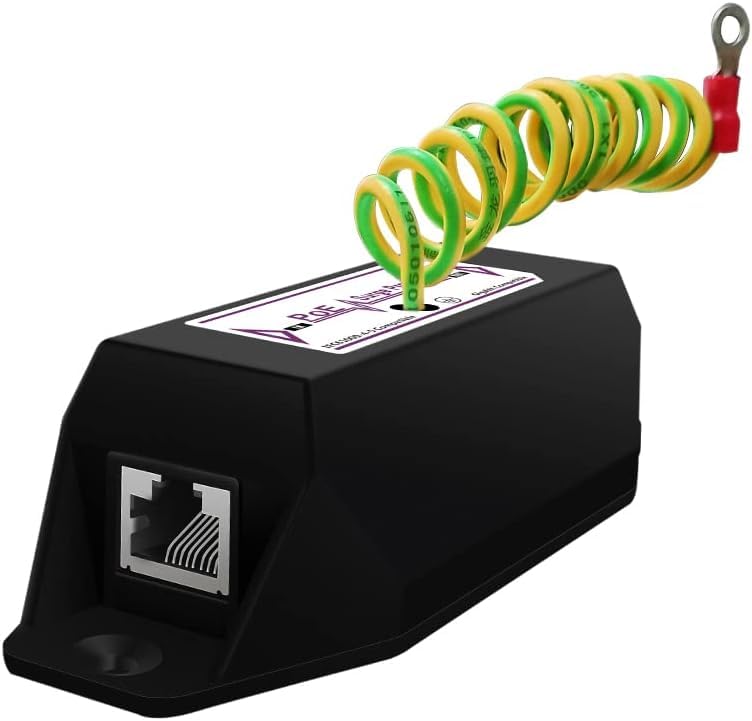
Gigabit PoE+ Ethernet Surge Protector 10KV Lightning Suppressor LAN Network CAT5/CAT6 Thunder...
- Gas Discharge Tubes(GDT) and Transient Voltage Suppressor(TVS) provide dual protection.
- Compatible with 802.3af/at ,support PoE+ 30w (0.6A/48V) and 10/100/1000 Base-T networks.
- 10KV lightning protection for all 8 pins of RJ45 ports.
If you install PoE cameras or switches outdoors or near lightning-prone areas, choose the Gigabit PoE+ Ethernet Surge Protector 10KV (model: PoE-SP10K-Gb) for reliable line defense. You get dual protection from Gas Discharge Tubes and TVS devices, rated 10KV across all eight RJ45 pins. It supports PoE+ 30W (0.6A/48V), 802.3af/at, and 10/100/1000Base-T on CAT5/5e/6. To install, plug the shielded RJ45 into the protector, attach the outgoing cable, mount using the included wall bracket, and connect the 17AWG ground wire to earth. Use it for PoE cameras, switches, and routers.
Best For: installers and users who need robust surge protection for outdoor or lightning-prone PoE networks using Gigabit PoE+ cameras, switches, or routers.
Pros:
- Dual protection with Gas Discharge Tubes (GDT) and TVS for enhanced surge suppression across all 8 RJ45 pins.
- Supports PoE+ (30W/0.6A/48V), 802.3af/at and Gigabit (10/100/1000Base-T) on CAT5/5e/6 for wide compatibility.
- Plug-and-play shielded RJ45 design with wall-mount and 17AWG ground wire for straightforward installation.
Cons:
- Protects only the Ethernet line; does not replace secondary grounding or whole-site lightning protection.
- Requires a proper earth ground connection (17AWG) to be effective, which may be inconvenient in some installations.
- May not handle extremely large, direct lightning strikes despite 10KV rating — best as part of a layered protection strategy.
Recommended Products

Gigabit Ethernet PoE Lightning/Surge Supressor Protector 70V Clamping

DIN Rail Ethernet Surge Protector - Gigabit GbE PoE/High PoE+ (HPoE) 1000 Mbps LAN Ethernet Network
Ethernet Gigabit Surge Protector Kit with CAT6a Jumper Cable and Ground Wire

Ethernet Gigabit Surge Protector Kit with CAT 6a Jumper Cable and Ground Wire (Supports POE++, POE...
- 🛡️ PROTECTS single port-to-port RJ45 Modem, Router, Switch, Patch Panel, Security Camera, CCTV, VoIP, WiFi Access Point, Computer, Gaming Console, NAS drive, TV, AV...
- ⚡ GIGABIT, POE/POE+/POE++, non-POE compliant, 10/100/1000M transmission rates. Working Voltage (Un) 48V/DC. Max. Continuous Operating Voltage (Uc) 65V/DC. Rated current...
- 👜 KIT INCLUDES CAT 6a Ethernet jumper cable, 2 foot AWG 14 ground wire with #10 ring terminal connection.
Professionals installing outdoor cameras or PoE switches will prefer this Ethernet Gigabit Surge Protector Kit because it includes a 2-foot CAT6a jumper cable and a 2-foot AWG 14 ground wire with a #10 ring terminal for secure grounding. You can protect PoE++, PoE+, PoE, and non-PoE devices like cameras, switches, and WiFi access points. Install by routing RJ45 port-to-port, connect CAT6a jumper, then attach AWG 14 ground to a known earth point using the #10 ring terminal. Supports 10/100/1000M, 48V/DC working voltage, 65V/DC max, 2A rated, 3kA (8/20μs) discharge, 1 ns detection.
Best For: Professionals and installers deploying outdoor PoE cameras, switches, and access points who need a compact gigabit surge protector with included CAT6a jumper and grounding wire for fast, reliable installation.
Pros:
- Includes 2-foot CAT6a jumper and 2-foot AWG 14 ground wire with #10 ring terminal for easy, secure grounding and quick port-to-port connection.
- Supports PoE++, PoE+, PoE and non-PoE devices at gigabit speeds (10/100/1000M) with no discernible speed loss.
- Fast protection response (1 ns) with a 3kA (8/20µs) max discharge rating and suitable voltage/current specs for typical PoE setups (48V/DC working, 65V/DC max, 2A rated).
Cons:
- 2-foot jumper and ground lead may be too short for some installation layouts, requiring additional cabling or repositioning.
- Rated discharge current (3kA) may be insufficient for extremely high-energy surge events in certain environments.
- Not a full-system lightning protection solution; proper grounding and complementary surge/mains protections are still recommended.
CERRXIAN Ethernet Surge Protector Gigabit PoE DIN Rail RJ45 Network Surge Protector
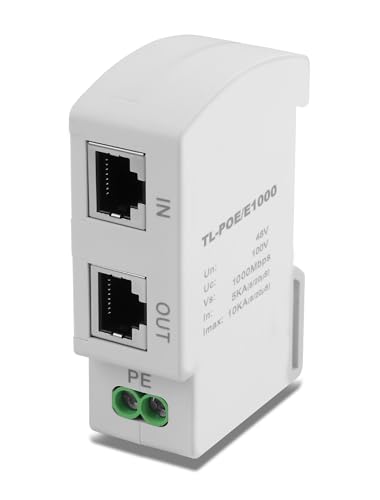
CERRXIAN Ethernet Surge Protector Gigabit PoE DIN Rail RJ45 Network Surge Protector LAN Network...
- Gigabit PoE Surge Protector for Lightning Protection: This advanced Gigabit PoE surge protector is designed to shield your high - speed network communication lines from...
- High - Performance Gigabit PoE with Multi - Level Protection: Equipped with a multi - stage protection circuit, this surge protector offers exceptional performance. It...
- Gigabit PoE Surge Protector with Durable Construction: The Gigabit PoE surge protector features a convenient hanging or rail - mounted design, making installation quick...
Choose the CERRXIAN Ethernet Surge Protector when you need a compact, DIN-rail mounted device that protects Gigabit PoE equipment from lightning and surge events. You mount it on a standard DIN rail or hang it in a rack, then connect RJ45 lines and a grounding terminal. It supports 48V continuous, 10KA max discharge, 8V residual, 10ns response, ≤0.2dB insertion loss. Use the 16- or 24-circuit 19-inch rack version for many ports. Operate between -25℃ and +65℃, humidity ≤95%. For outdoor cameras and wireless bridges, you can install it at the network edge for reliable surge protection.
Best For: Network engineers and installers needing compact DIN-rail or rack-mounted surge protection for Gigabit PoE devices (outdoor cameras, wireless bridges, switches) in harsh environments.
Pros:
- Protects Gigabit PoE lines with 48V continuous rating, 10kA max discharge and low 8V residual voltage.
- Fast 10ns response and ≤0.2dB insertion loss preserve network performance.
- Flexible mounting (DIN-rail or 19″ 16/24-port rack options) and wide operating range (-25℃ to +65℃, ≤95% humidity).
Cons:
- Requires proper grounding to be effective; not a standalone solution for all surge scenarios.
- Limited to 48V PoE systems — may not suit non-PoE or higher-voltage equipment.
- Max discharge rating (10kA) may be insufficient for extremely high-energy lightning strikes in some locations.
Ubiquiti Networks ETH-SP Poe External Surge Suppressor
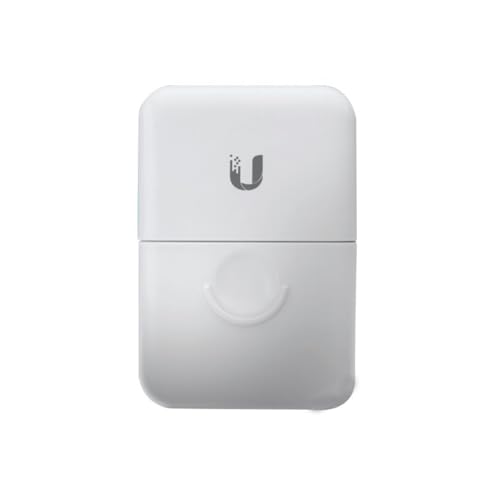
Ubiquiti Networks ETH-SP Poe External Surge Suppressor
- Low-Cost Protection and Fast Installation
- Protects Outdoor Ethernet Devices
- Compatible with 10/100/1000 Mbps Networks
Network installers who deploy outdoor IP cameras or gigabit PoE devices will find the Ubiquiti ETH-SP Poe External Surge Suppressor a practical choice because it protects RJ45 10/100/1000 links and IEEE 802.3af power over Ethernet. You can mount it inline on the data lead, connect both RJ45 ends, and ground the unit per local code. It absorbs transient current from 100V/µs to 1kV/µs and limits capacitance to 1.0 pF at 1 MHz, preserving signal integrity. ETSI300-019-1.4 certification proves shock and vibration resistance. Operate between -30°C and 65°C, 10–90% non-condensing humidity.
Best For: Network installers and integrators deploying outdoor IP cameras or gigabit PoE devices who need inline surge protection for RJ45 10/100/1000 links with minimal signal impact.
Pros:
- Protects Ethernet and IEEE 802.3af PoE lines from fast transients (100V/µs to 1kV/µs) while maintaining signal integrity (≤1.0 pF at 1 MHz).
- Rugged and reliable for outdoor or harsh environments with ETSI300-019-1.4 shock/vibration certification and wide operating conditions (-30°C to 65°C, 10–90% non-condensing humidity).
- Simple inline installation with RJ45 connections and grounding per local code for versatile deployment with IP cameras and other PoE devices.
Cons:
- Designed for IEEE 802.3af PoE only—may not support higher-power PoE standards (e.g., 802.3at/af variants) without verification.
- Adds an inline component that requires proper grounding and physical protection, which can complicate installations in tight or exposed spaces.
- Provides protection limited to Ethernet/P0E lines and does not replace comprehensive facility-wide surge protection for AC power or other cabling.
Tupavco Ethernet Surge Protector Gigabit PoE++ (TP302)
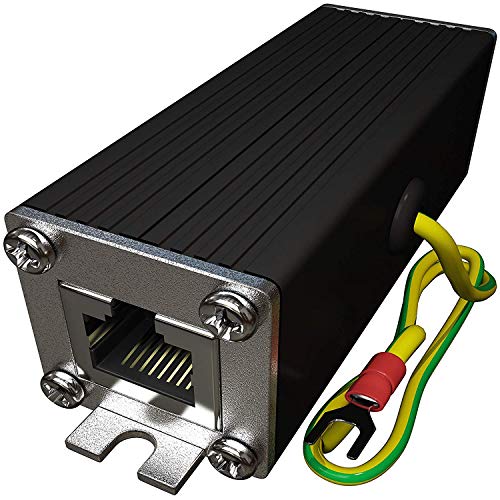
Tupavco Ethernet Surge Protector Gigabit High PoE++ Class 8 (154W/3.2A) TP302
- Ethernet Surge Protector for Gigabit GbE PoE/High PoE++ (HPoE) 1000 Mbps LAN Ethernet Network
- Gas Discharge Tubes for Full Protection GDT - Lightning Suppressor RJ45 Cable Protection CAT6/CAT5
- Aluminum Case,Ground Wire 12AWG,Line-Line Line-Ground Protection,Bidirectional Clamping,20KA 8/20μs
If you need a high-power, rack- or wall-mountable surge suppressor for PoE++ devices, the Tupavco TP302 is a strong choice because it handles up to 154W at 48V and supports IEEE 802.3 af/at/bt standards. You can mount the aluminum-case TP302 using included flanges to a wall, panel, or rack. Connect CAT5/CAT6 to metal-shielded RJ45 ports, bond the 12AWG ground wire to earth, and verify bidirectional clamping is active. It offers 20KA 8/20μs thunder arrestor protection and line-line, line-ground defense. Use for routers, switches, modems, and PoE cameras.
Best For: Network installers and IT teams needing a rack- or wall-mountable surge protector for high-power PoE++ devices (cameras, switches, routers) that require up to 154W at 48V and IEEE 802.3 af/at/bt compatibility.
Pros:
- Aluminum case with metal-shielded RJ45 and 12AWG ground provides robust physical protection and grounding for CAT5/CAT6 connections.
- Supports PoE++ (3.2A / 4 pairs) and up to 154W at 48V, suitable for high-power PoE devices.
- 20kA 8/20µs bidirectional clamping with line-line and line-ground protection for effective lightning/surge suppression.
Cons:
- Requires proper grounding (bonding the 12AWG ground) and correct installation, adding installation steps and potential electrician work.
- Bulkier metal enclosure may be overkill for small or low-power deployments where compact solutions suffice.
- Specific surge rating and protection effectiveness depend on overall site grounding and external surge sources; not a standalone guarantee against all lightning damage.
CERRXIAN RJ45 Ethernet Surge Protector for POE Network Devices

CERRXIAN RJ45 Ethernet Network Surge Protector Outdoor Arrester Protection Device for POE Switch...
- The Network Surge Protector Suppressors protects a single data line, including computer network signals, communication equipments and more. Insert a Network Surge...
- Multi-level protection circuit, high-speed protection accessories, low capacitance design, fast response, low output residual voltage and superior transmission...
- The standard RJ45 shielded interface of Ethernet Network Surge Protector is suitable for overvoltage protection of ETHERNET 10/100M BASET network equipment (such as...
The CERRXIAN RJ45 Ethernet Surge Protector is best for outdoor PoE camera and switch installations that need a low-capacitance, high-speed protection device. You can use this CERRXIAN unit to protect 10/100M BASET devices like SWITCH, HUB, and ROUTER equipment. Insert the protector inline between the external signal cable and device input, using the identical RJ-45 connectors on both sides. Connect the green ground wire to a true earth ground. The multi-level protection circuit responds quickly and minimizes residual voltage. It suppresses lightning and industrial surges, preserves transmission, and reduces replacement costs for POE cameras and switches.
Best For: Outdoor PoE camera and network installations (10/100M) where low-capacitance, high-speed surge protection is needed to safeguard switches, hubs, routers, and PoE devices.
Pros:
- Protects PoE cameras and network equipment from lightning and industrial surges with a multi-level, fast-response circuit.
- Low capacitance design minimizes residual voltage and preserves Ethernet transmission integrity.
- Simple inline installation with identical RJ-45 connectors and a ground wire for flexible, tool-free deployment.
Cons:
- Requires a proper earth ground connection (green wire) to be effective, which may not always be available or easy to access.
- Designed for 10/100M BASET only, so it may not be suitable for gigabit (1000Base-T) networks.
- Outdoor exposure still depends on enclosure/weatherproofing of the unit and connections; additional protection may be needed in harsh environments.
Factors to Consider When Choosing a Poe Surge Protector
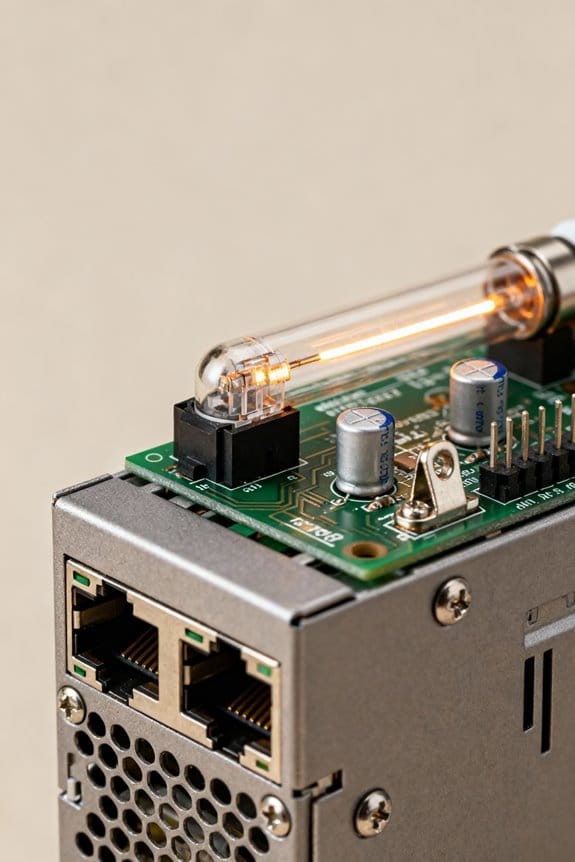
When you choose a PoE surge protector, check the PoE power rating (for example 802.3at 30W or 802.3bt 90W) to match your device’s wattage. Verify surge current capacity, such as 10kA or 20kA per line, and note the protection technology type (MOV, TVS, or gas tube) so you can compare response and lifespan. Also confirm data speed compatibility (10/100/1000 Mbps or 2.5G/5G), grounding requirements (solid earth connection, <5 ohm recommended), and any product codes like CERRXIAN RJ45-POE-01 for proper replacement.
PoE Power Rating
Because you’ll match device needs to protector capacity, start by checking the PoE power rating in watts (W) and the current rating in amps (A). You should confirm the protector supports the device’s maximum power, for example 30W for PoE+ (IEEE 802.3at) or up to 154W for PoE++ (IEEE 802.3bt). Check current ratings like 1.6A for two-pair and 3.2A for four-pair configurations. Verify maximum input voltage, typically ~48V DC, and ascertain the protector’s maximum continuous operating voltage (Uc) exceeds your equipment voltage. Match IEEE standards (af/at/bt) to guarantee compatibility. As a step, list each device power need, add a 20% headroom margin, then select a protector whose W, A, and Uc meet those totals.
Surge Current Capacity
After you confirm wattage and current ratings, check a protector’s surge current capacity, measured in kiloamperes (kA). You should pick a protector rated to exceed possible surge levels in your environment. Most PoE protectors range from 5 kA to 20 kA. A 10 kA unit will handle common surge events. Choose 15 kA or higher for locations prone to severe electrical disturbances. Also verify the protector’s residual voltage; lower residual voltage means less stress on devices during a surge. Step 1: identify local surge risk (lightning, industrial equipment). Step 2: select a protector with capacity above peak risk, for example 10 kA or 20 kA models. Step 3: confirm surge capacity and residual voltage on the datasheet before purchase.
Protection Technology Type
Protection technology type tells you how a PoE surge protector deflects or absorbs dangerous voltage spikes, so pick devices that match your risk and equipment. You should choose models with Gas Discharge Tubes (GDT) for line-line and line-ground lightning protection. Look for compatibility with IEEE 802.3af/at/bt to handle 15V–56V PoE devices. Prefer multi-mode protection that covers common mode and differential mode surges. Verify surge current ratings of 5KA or 10KA to withstand strong lightning events. Check residual voltage ratings and response times, aiming for ≤1ns or ≤10ns and low clamping volts, e.g., ≤90V for 48V systems. Install inline per manufacturer steps, grounding per code, and test after connection.
Data Speed Compatibility
You already checked protection types like GDT and surge current ratings; now confirm the surge protector matches your network’s data speed. First, verify the unit supports 10/100/1000 Mbps (Gigabit). Check the datasheet line that reads “10/100/1000” or model code like SP-POE-GbE. Second, verify PoE standard compatibility: look for IEEE 802.3af, 802.3at, or 802.3bt markings to match power and data needs. Third, confirm response time under 1 ns to protect transients without corrupting packets. Fourth, check insertion loss is below 0.5 dB on the spec sheet. Finally, match bandwidth to applications such as HD surveillance; if you run 1080p, allocate Gigabit capacity and document model, serial, and firmware versions during installation.
Grounding Requirements
Because a proper earth reference routes surge energy away from equipment, you should connect the surge protector’s ground conductor directly to a verified grounding point using the supplied 12 AWG (or 14 AWG if specified) wire. You must attach the wire to the protector’s ground terminal marked GND or ⏚. Next, verify the grounding point with a multimeter; the resistance should be below 5 ohms per local code, often 25 ohms maximum where specified. Follow these steps: strip 12 mm insulation, insert conductor, tighten terminal screw to 20–25 in-lb torque, and secure the other end to a building grounding rod or panel lug. Ascertain the grounding system complies with NEC or local standards to minimize residual voltage and protect equipment.
Installation Location Options
Location matters: when choosing where to mount a PoE surge protector, place it at the network entry point within 0.5–3 meters of the incoming cable riser to intercept surges before they reach devices. You can install protectors indoors or outdoors. For indoor use, mount units near switches or routers, keeping cable runs under 1–2 meters to reduce exposure. For outdoor runs, pick weather-resistant models and mount at shelter or enclosure entry. Use wall, DIN-rail, or rack-mounted options per equipment layout; follow manufacturer part codes like SPD-POE1 or TP-SPD24 for compatibility. Ascertain proper grounding per the prior section, and verify mounting height allows easy access. Step 1: locate entry. Step 2: secure protector. Step 3: connect and test.
Environmental Durability
After you’ve mounted a PoE surge protector near the network entry point, check the unit’s environmental durability before finalizing installation. You should confirm an operating temperature range like -40°F to 185°F (-40°C to 85°C). Verify weather-resistant ratings for outdoor models to resist rain and snow. Ascertain the unit tolerates high humidity up to 95% non-condensing to avoid moisture damage. Inspect materials; choose corrosion-resistant housings such as aluminum or zinc alloy, model codes often list “AL” or “ZA.” Check shock and vibration test reports, for example MIL-STD-810G or IEC 60068 compliance, and note any G-force values. Finally, follow manufacturer step-by-step installation limits and mounting torque specs to maintain rated durability.
Frequently Asked Questions
Will Surge Protectors Affect Poe Device Data Throughput?
Yes, surge protectors can slightly affect PoE data throughput if they add inline components. You can choose models rated for 10/100/1000 Mbps, like APC ProtectNet PNET1GB or Tripp Lite TPE1G, to avoid drops. Install per instructions: power down, connect Ethernet IN to protector port 1, OUT to device port 2, ground to a <5 ohm earth stake. Test with a 1 Gbps Ethernet tester, verify <0.1% packet loss.
Can Surge Protectors Be Used With Fiber-To-Ethernet Media Converters?
Like a bridge, you can connect converters with surge protectors to guard equipment. You can install a surge protector rated for data lines, e.g., Belkin F9E300-06 (10/100/1000 Mbps) or APC PNET1GB, between fiber-to-Ethernet media converters and switches. You can mount inline on the RJ45 port, guarantee <1 ns latency, max 10 V clamp, and follow: power down, plug cable into protector, connect protector to device, power up and test throughput with iPerf.
How Often Should Surge Protectors Be Inspected or Replaced?
You should inspect surge protectors every 6 months and replace them every 3–5 years or after a major surge. Check indicator LEDs, model numbers, and MOV status. Use a multimeter to verify continuity and clamp-to-ground <10 ohms. For model SPD-POE-1201, remove power, disconnect cables, test, then reinstall. Replace if LED is off, MOV is bulged, or if measured resistance exceeds specified limits in the manual.
Do Surge Protectors Protect Against Nearby Lightning-Induced Ground Potential Rise?
You can partially protect against nearby lightning-induced ground potential rise, but not fully. Use a rated protector like SPD Class I/II, 10 kA (8/20 µs) or part number TLP-1000-POE. Bond ground within 0.5 m using 6 AWG copper, then mount protector at building entry. Test with a clamp meter, record continuity <0.1 Ω. Replace after any surge >5 kA or after 3–5 years, per manufacturer.
Are Surge Protectors Compatible With Power Over Hdbaset Equipment?
Yes, you can use surge protectors with PoE over HDBaseT equipment. Install inline protectors rated for 10/100/1000Base-T or HDBaseT, such as TE Connectivity SP1000-1 or L-com HGJ1GB. Mount them within 0.5 meters of the powered device, use Cat6a shielded cable, and bond shields to a single-point ground. Verify clamping voltage ≤600V and response time ≤1ns. Test continuity and replace units after a surge event.